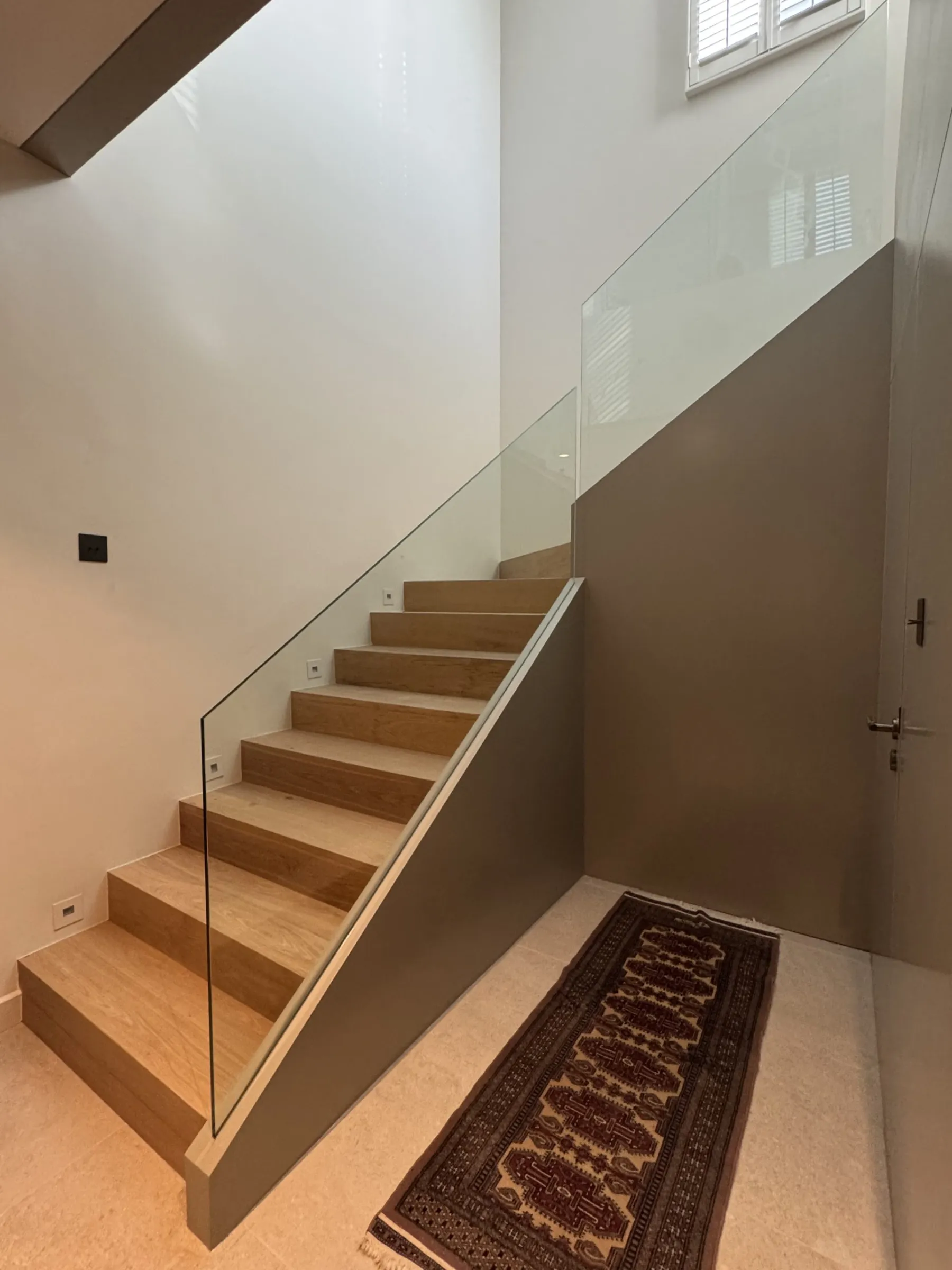
Dining room renovation in Dubai – remodeling and fit-out for formal, open-plan and majlis dining
Abdulla Carpentry EST has been building dining rooms in Dubai since 1984. Tables, sideboards, crockery units, panelling, ceilings and lighting designed and made in our own Ras Al Khor workshop and fitted by our own team.
A dining room renovation in Dubai is a joinery and lighting job more than a building one. The feature wall behind the table, the crockery or bar cabinet, the ceiling and the light over the table do almost all the work, and none of them need plumbing or structure. That is why a dining room is one of the quickest rooms in a home to change and one of the easiest to get approved.
A finishes-and-lighting refresh runs AED 15,000 to 40,000; a full room with bespoke joinery runs AED 40,000 to 140,000. Most dining rooms take one to two weeks on site once the joinery is manufactured. Abdulla Carpentry EST designs, makes and fits the table, the cabinetry, the panelling, the ceiling and the lighting under a single contract.
Dining room renovation in Dubai: the company and the workshop
Abdulla Carpentry EST is a dining room renovation company working across Dubai since 1984. Dining room remodeling, a dining room fit out, a dining room revamp, a dining room makeover and a dining area upgrade all describe different depths of the same job, and we price a dining room renovation in Dubai against scope rather than against the word used. A refresh changes paint, lighting and a feature wall; a full fit-out changes everything including the table.
The reason this room suits a joinery company is that almost everything in it is made rather than bought. The table, the sideboard, the crockery unit, the bar cabinet and the wall panelling are machined, sprayed and assembled in our Ras Al Khor workshop, which is why a 2,600mm table or a 3,150mm wall of cabinetry costs what a catalogue size costs.
 1984Building dining rooms in Dubai
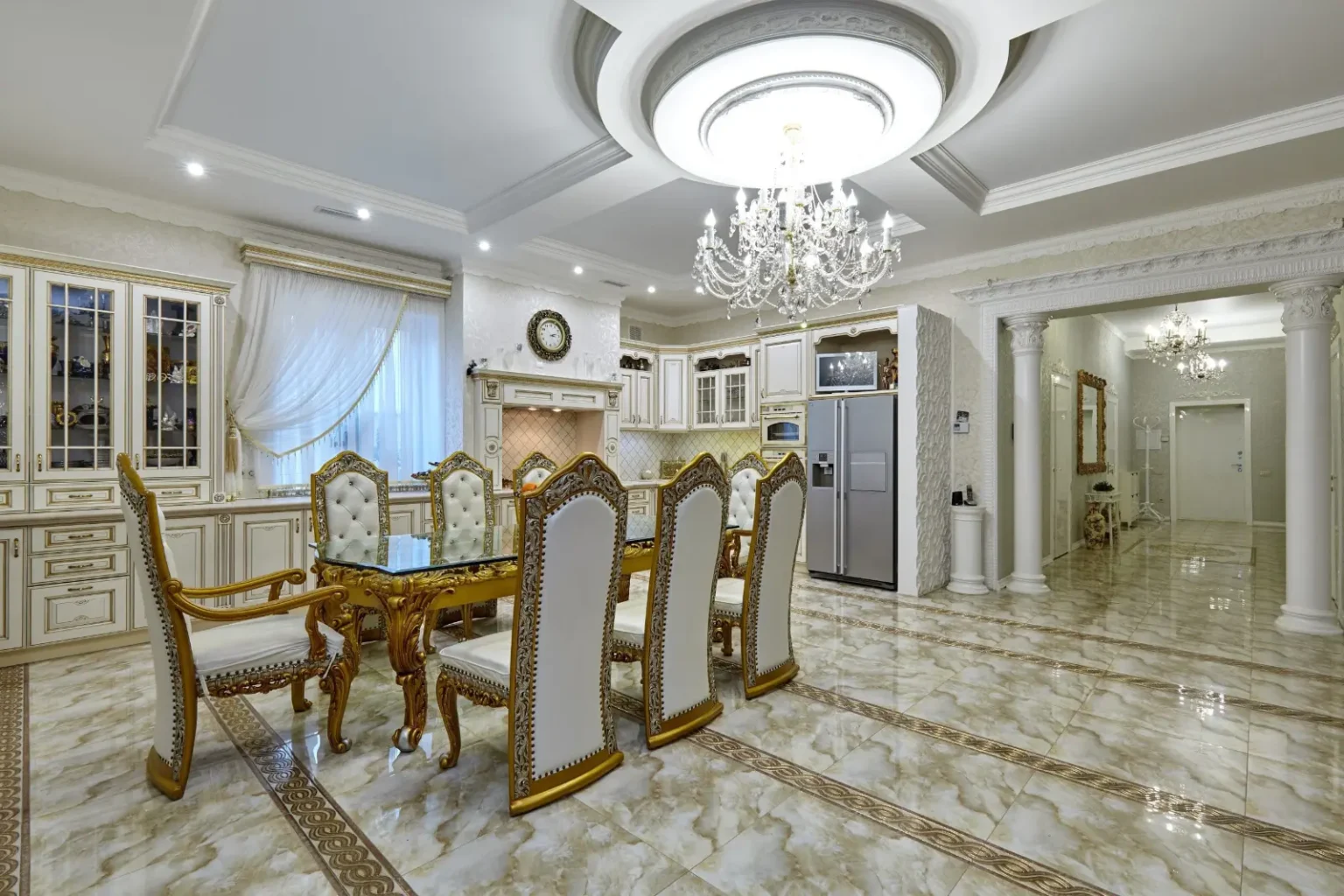
Dining room interior design in Dubai divides into a few recognisable briefs. A modern dining room means a long table, a linear pendant and one quiet feature wall. A luxury dining room adds stone, mirror and a chandelier. Minimalist dining hides the storage completely. A classic dining room keeps wainscoting, a formal sideboard and a round or oval table. Arabic-style dining leans toward a larger table, floor seating nearby and a generous serving run.
Every dining room renovation in Dubai starts with a free site visit and a written dining room quotation. We measure the room, check the ceiling height and the chandelier drop, find the AC diffusers and the switch positions, and come back with a 3D dining room design so you can see the panelling and the cabinet elevation before anything is cut. Clients regularly ask for before and after sets and for dining room ideas from recent projects – that is what the 3D design and consultation stage is for.
Formal dining room makeover
A formal dining room renovation in Dubai produces a room you use properly a few dozen times a year and want to look right every one of them. A separate dining room with a door is still the preference in most Dubai villas, because it contains the noise, holds the smell of the food and lets you leave a table laid without the whole house seeing it.
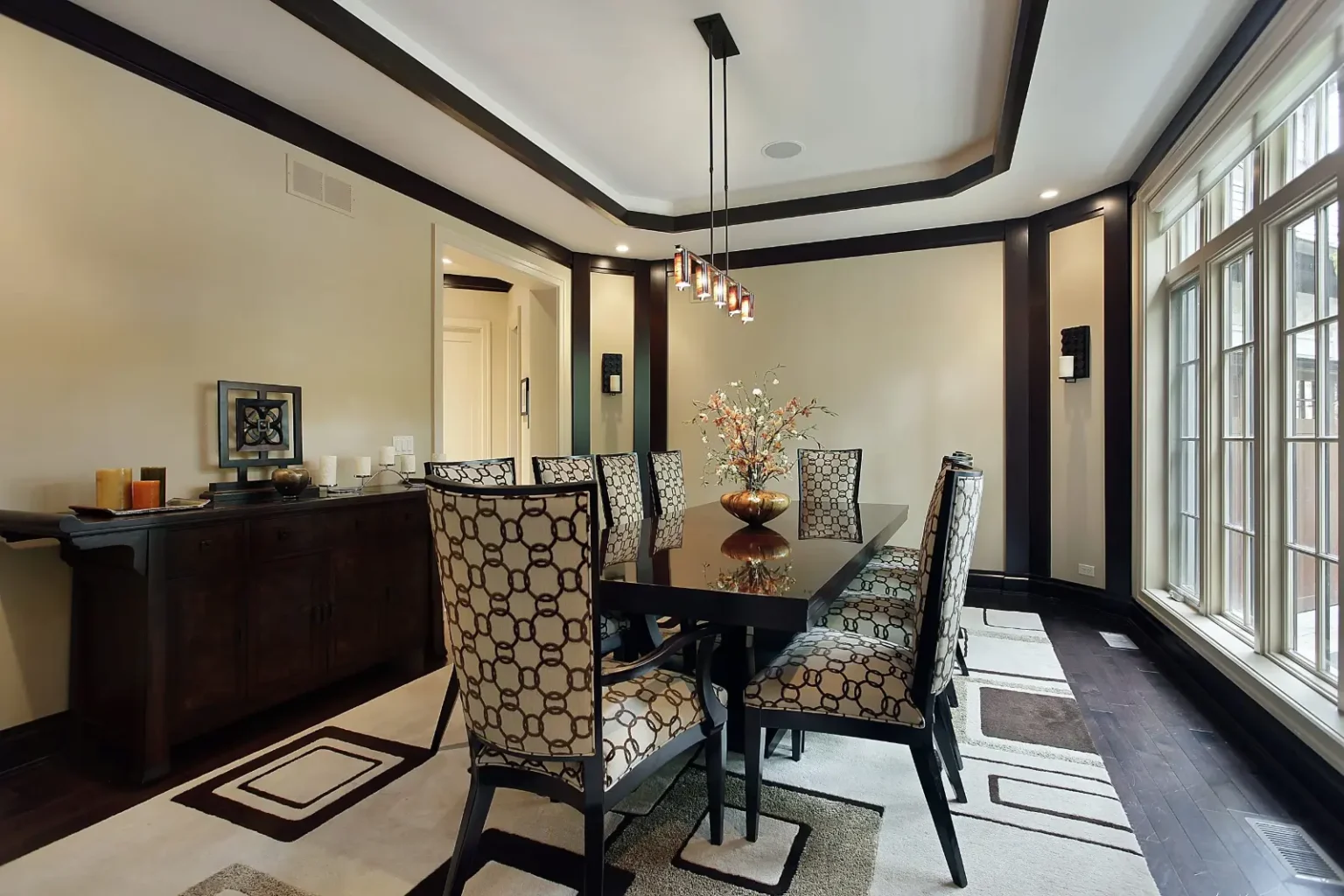
A dining room for entertaining is sized by the table, not the room. An 8-seater needs about 2,400mm of table and a metre of clear space on every side to pull a chair out; a 10 to 12 seater dining room needs 3,000 to 3,600mm of table and a room of roughly 4.5 by 5 metres before it stops feeling tight. We set this out on the drawing first and let the finishes follow.
A family dining room renovation in Dubai has a different brief again – a surface that survives homework and spilled juice, chairs that wipe clean, and storage within reach rather than a display cabinet. The honest answer there is often a hard-wearing veneer or laminate top with a solid timber edge rather than an open-pore oak slab that marks the first week.
Open-plan living and dining renovation
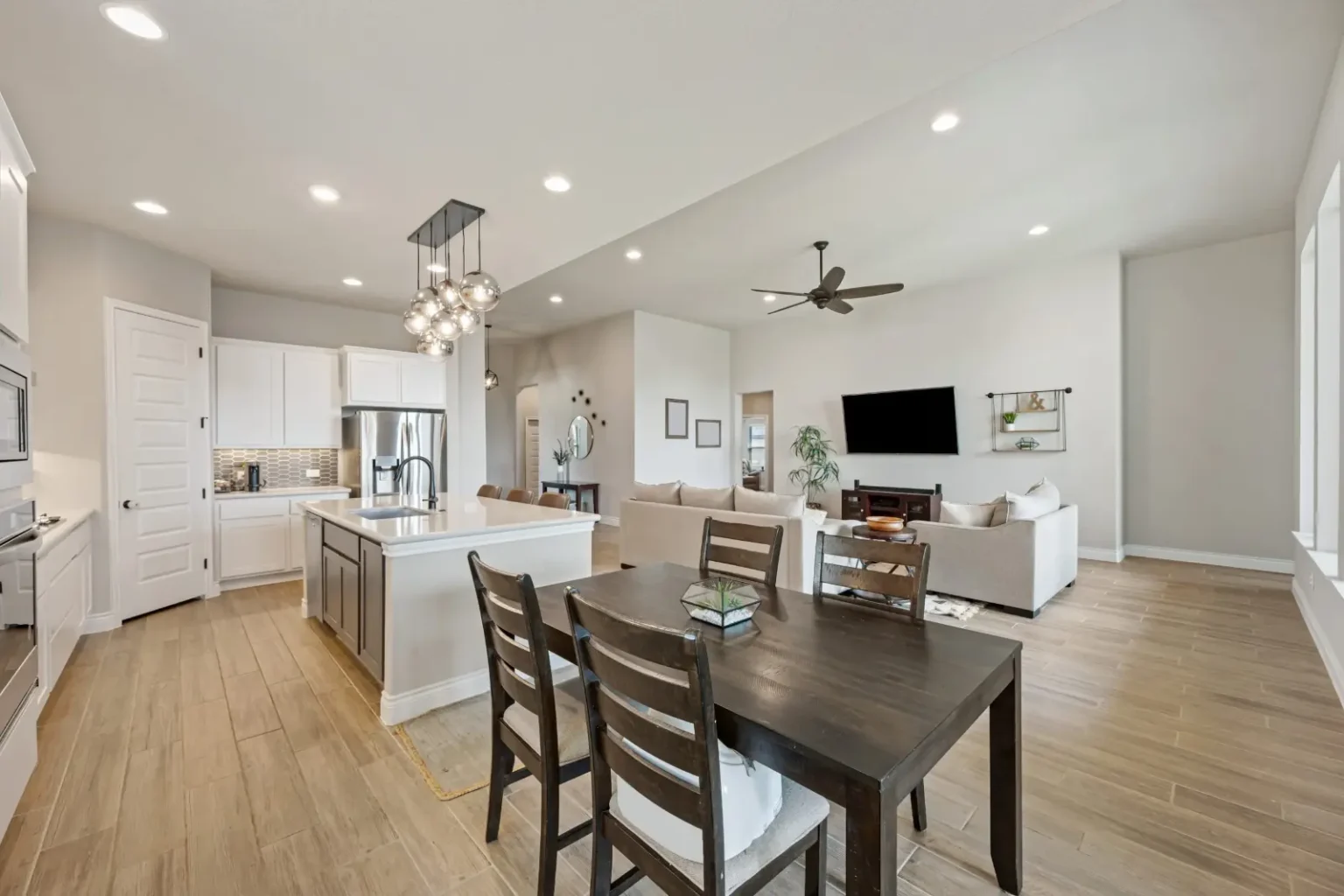
Open-plan dining is now the default for a dining room renovation in Dubai in apartments and in most new townhouses. A living and dining room renovation done well does not knock everything into one undifferentiated space – it keeps zones legible with a change of ceiling, a rug recess, a run of joinery or a light fitting that sits only over the table.
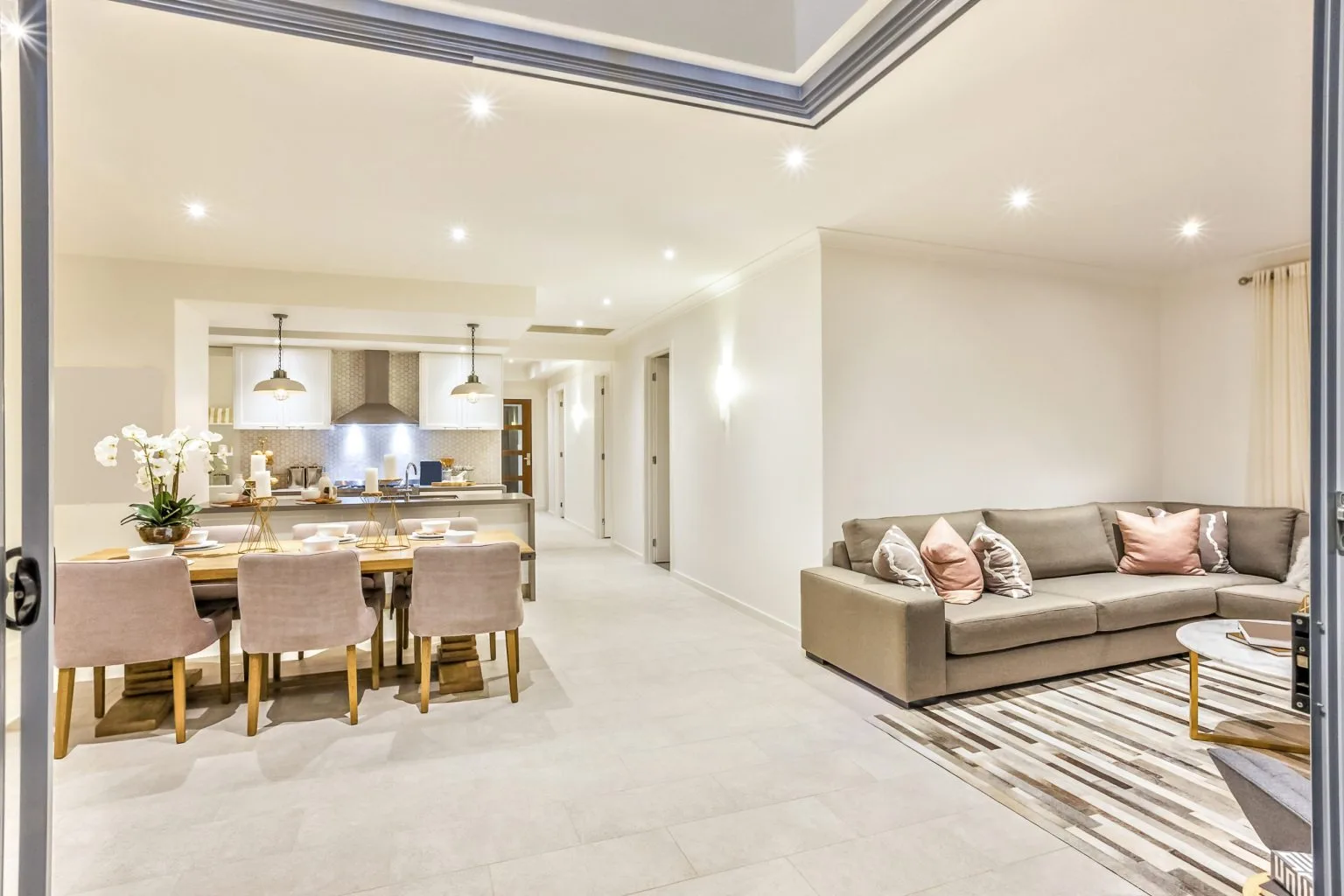
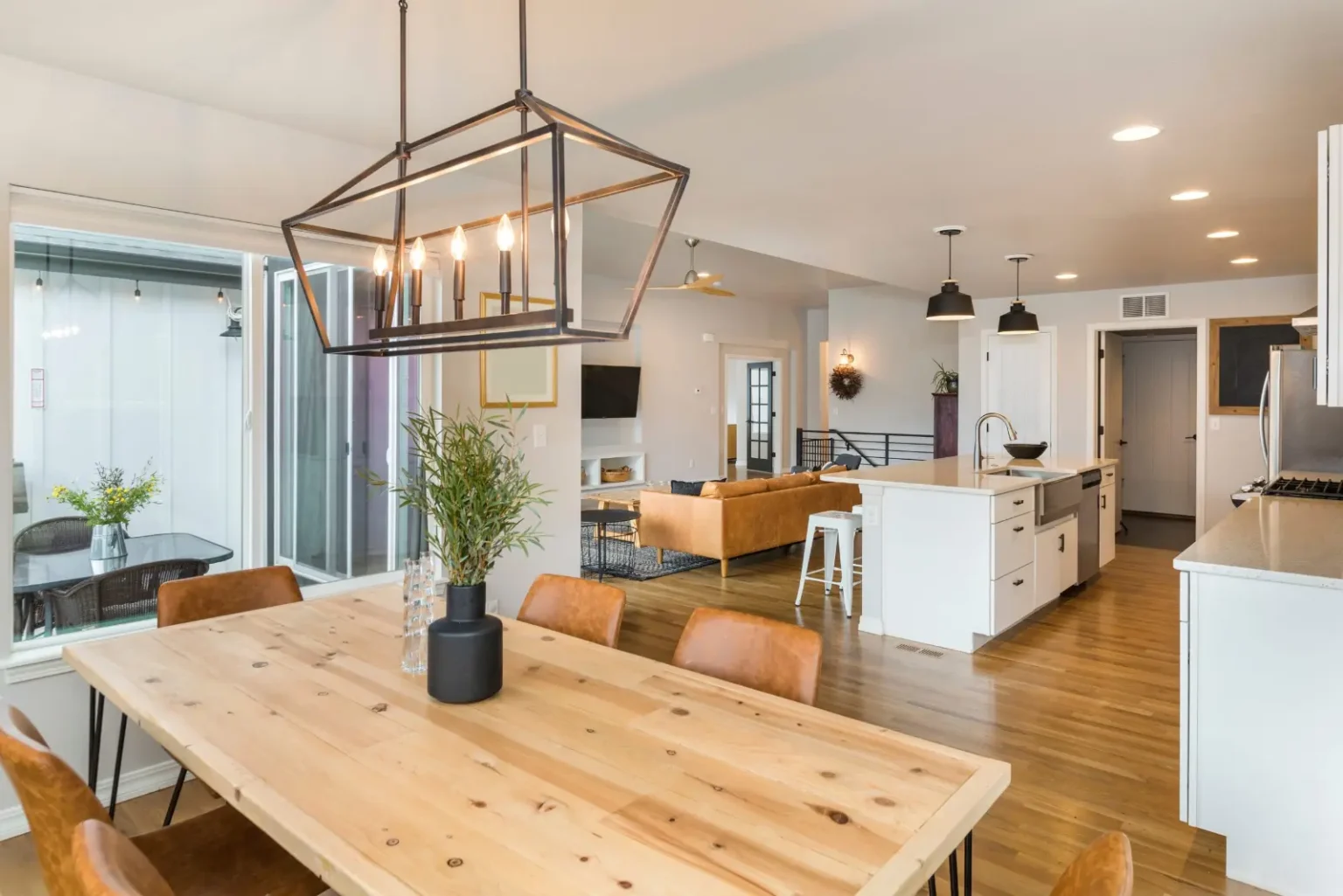
Kitchen and dining combined is the arrangement most clients actually live in. The risk is that the dining table becomes an extension of the kitchen worktop. A pendant run that belongs to the table, a different floor finish or a low sideboard between the two is usually enough to stop that without building a wall.
A dining nook or a breakfast area is the answer where a dining room renovation in Dubai has no room for a full table. Banquette seating along one wall buys you two chair-widths of floor and gives storage under the seat, which is the cheapest storage in any home. We build banquettes with lift-up or drawer bases depending on what is going in them, and upholster them in a wipe-clean fabric – see upholstery for cover options.
Dining feature walls, panelling and mirror walls
A feature wall is the highest-impact item in a dining room renovation in Dubai for the money. Dining wall panelling in fluted panels, wainscoting or full-height wood panelling gives the table something to sit against and makes an ordinary room look designed. An accent wall in a deeper colour, wallpaper or a textured wall finish costs least and is easiest to change later. See wall panelling for profiles and finishes.
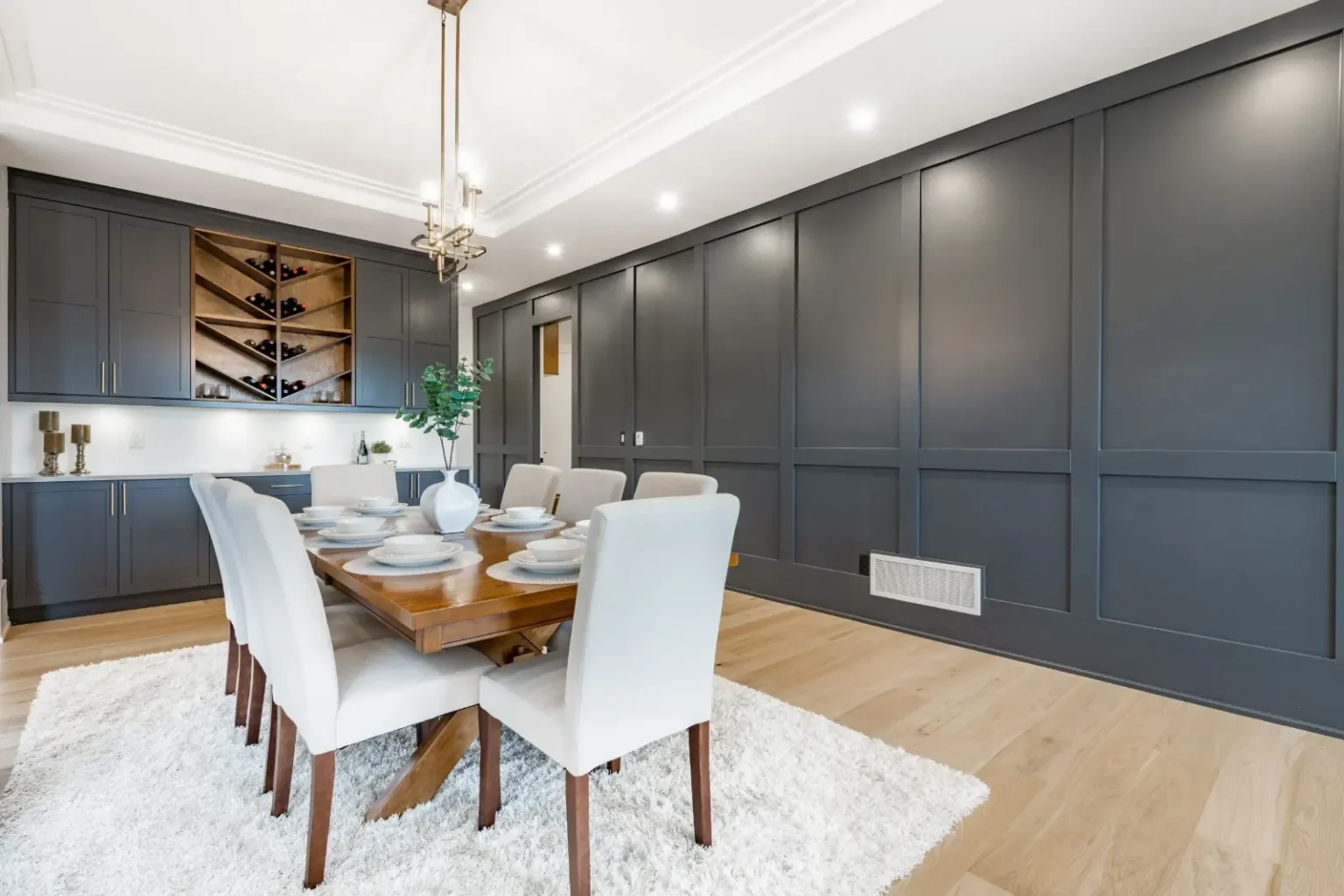
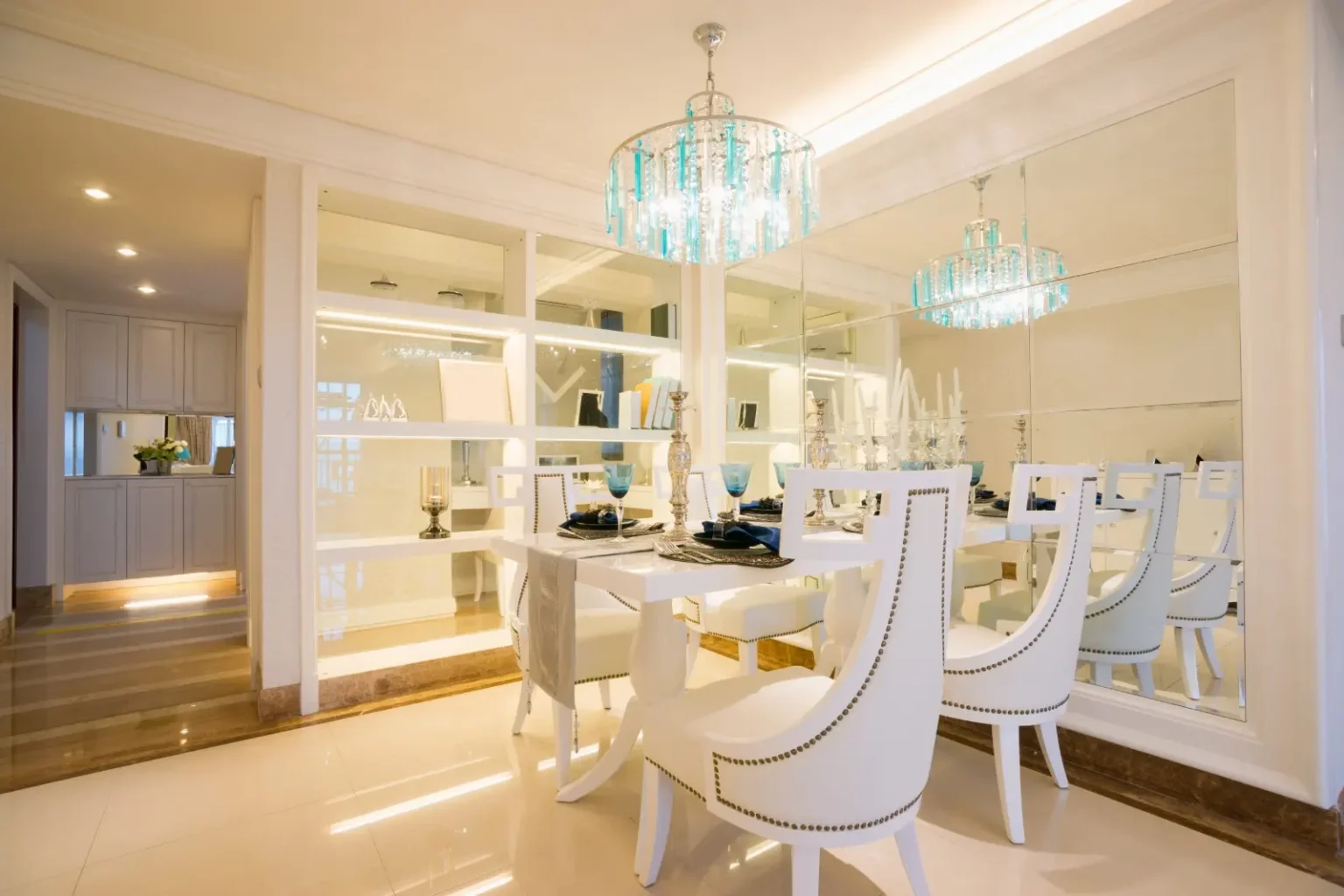
A mirror wall for a dining room is the oldest trick in the trade and still the most effective in a narrow space. A mirrored dining wall doubles the apparent width and bounces the chandelier twice. Antique mirror and bronze mirror panels soften the reflection so you are not looking at yourself eating, which is the usual objection to plain mirror. We cut, back and fit our own glass – see mirror works for finishes, panel sizes and edge details.
Panelling and mirror on a dining room renovation in Dubai work best set out to the room rather than to a standard sheet. Panels are made in the workshop and fitted as a system, so the joints land where you want them and you get a crisp shadow gap instead of filler on site. Switches, sockets and any wall light positions are fixed on the drawing before the panels are manufactured, never cut into them afterwards.
Dining cabinets, crockery units and bar cabinets
A dining cabinet is where a dining room renovation in Dubai stops being furniture and starts being joinery. A crockery cabinet, a sideboard or a buffet unit built wall-to-wall gives you more storage than two freestanding pieces, no dust gap above and no dead end panel. A display cabinet or a glass-front cabinet above a closed base is the classic split – show the glassware, hide everything else.
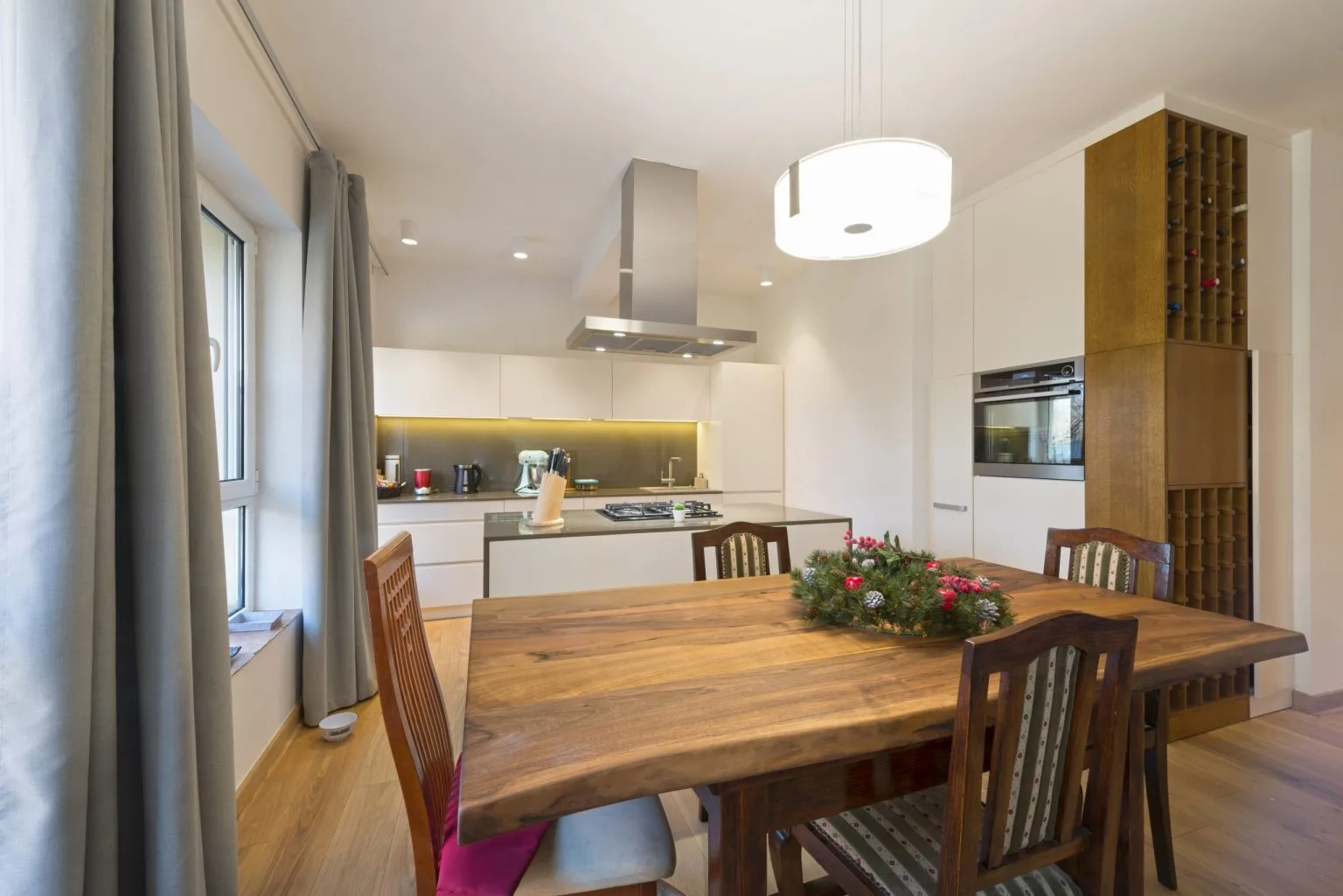
Built-in dining storage is sized to what actually goes in it. Drawers deep enough for table linen, a shelf height that takes a charger plate standing up, a section for the serving dishes that only appear twice a year, and soft-close on everything so a cabinet full of china is not a hazard. We draw the internal layout and you approve it before manufacture. See joinery for board, hardware and finish specifications.
A bar cabinet or a wine cabinet is the most-requested addition to a Dubai dining room. Bottle storage on its side, a glass rail, a worktop at standing height and a lockable section if you want one. A wine cabinet with a cooling unit needs ventilation and a power point designed in at the start, not a hole cut later. A coffee bar built into the same run wants a water point if you are plumbing a machine in, which is the one item here that touches a wet trade.
Everything in the run is made from the same board batch and sprayed together, which is why the colour matches across the wall. If you have existing dining furniture you are keeping, bring us a drawer front and we will match it in the spray booth and send a sample before production starts.
The table itself is the piece we are asked for most on a dining room renovation in Dubai. A custom dining table lets you size it to the room and the number of seats rather than the other way round – solid timber at AED 9,000 to 35,000, veneered at AED 6,500 to 18,000, or a marble dining table top at AED 12,000 to 45,000 depending on the stone. An extending mechanism adds AED 1,800 to 5,500 and is worth it in a room that has to do six most nights and ten at Eid. See stone works for slab selection and edge profiles.
Seating is the other half. Upholstered dining chairs made to match the table, built-in bench seating along a wall, or a banquette in the corner all change how many people the room actually holds. Reupholstering existing dining chairs at AED 280 to 750 each is often the better call than replacing them, because an older frame is usually better made than a new one at the same price.
Dining room false ceilings and lighting
A false ceiling does more for a dining room renovation in Dubai than for any other room. A gypsum ceiling lets you drop a tray or a recess directly over the table, which defines the dining zone in an open-plan space without a single wall. It also hides the AC ducting and gives you somewhere to build cove lighting. See ceiling works for build-ups.
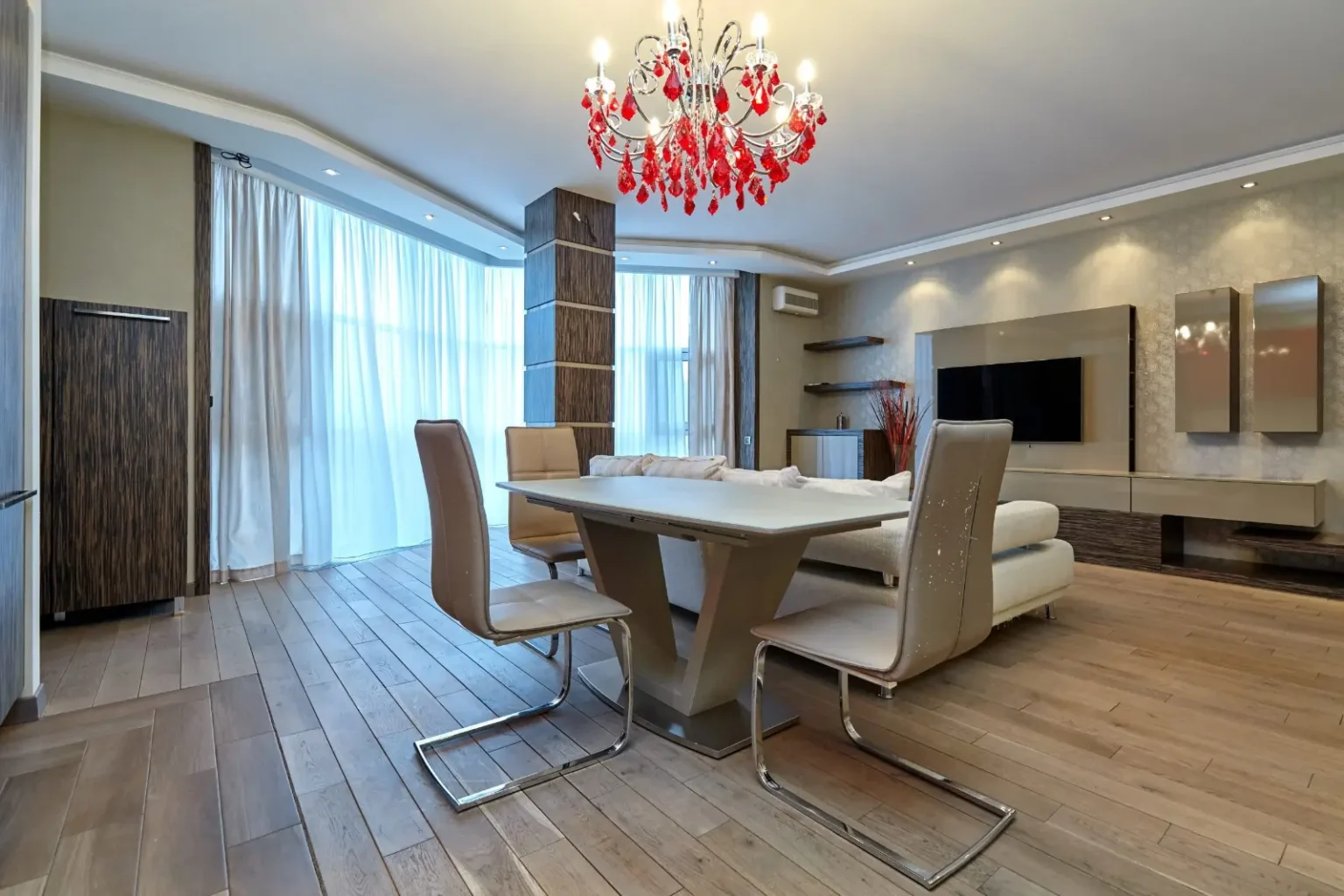
Chandelier installation is the item that goes wrong most often on a dining room renovation in Dubai. A heavy fitting needs a proper fixing back to the slab, not to the gypsum board, and the box has to be positioned over the centre of the table rather than the centre of the room – those two points are rarely the same. We set the position from the table drawing and install the backing before the ceiling is closed.
A pendant light over the table should hang 750 to 850mm above the tabletop so it lights the food without blocking the person opposite. Dimmable lighting matters more here than anywhere else in a home, because the same room has to work for homework at six and for guests at nine. Cove lighting around the perimeter and wall sconces on the feature wall give you the second and third layers. Our electricians set out the circuits and dimmers at first fix.
Dining room flooring and painting
Flooring on a dining room renovation in Dubai takes more abuse than people expect – chair legs, dropped cutlery and spills. Marble flooring and large-format porcelain tiles are the hardest-wearing and the most common in Dubai villas. Wooden flooring and engineered timber are warmer underfoot and quieter, and a herringbone or parquet lay reads as deliberate rather than as flooring. See flooring for build-ups and thresholds.
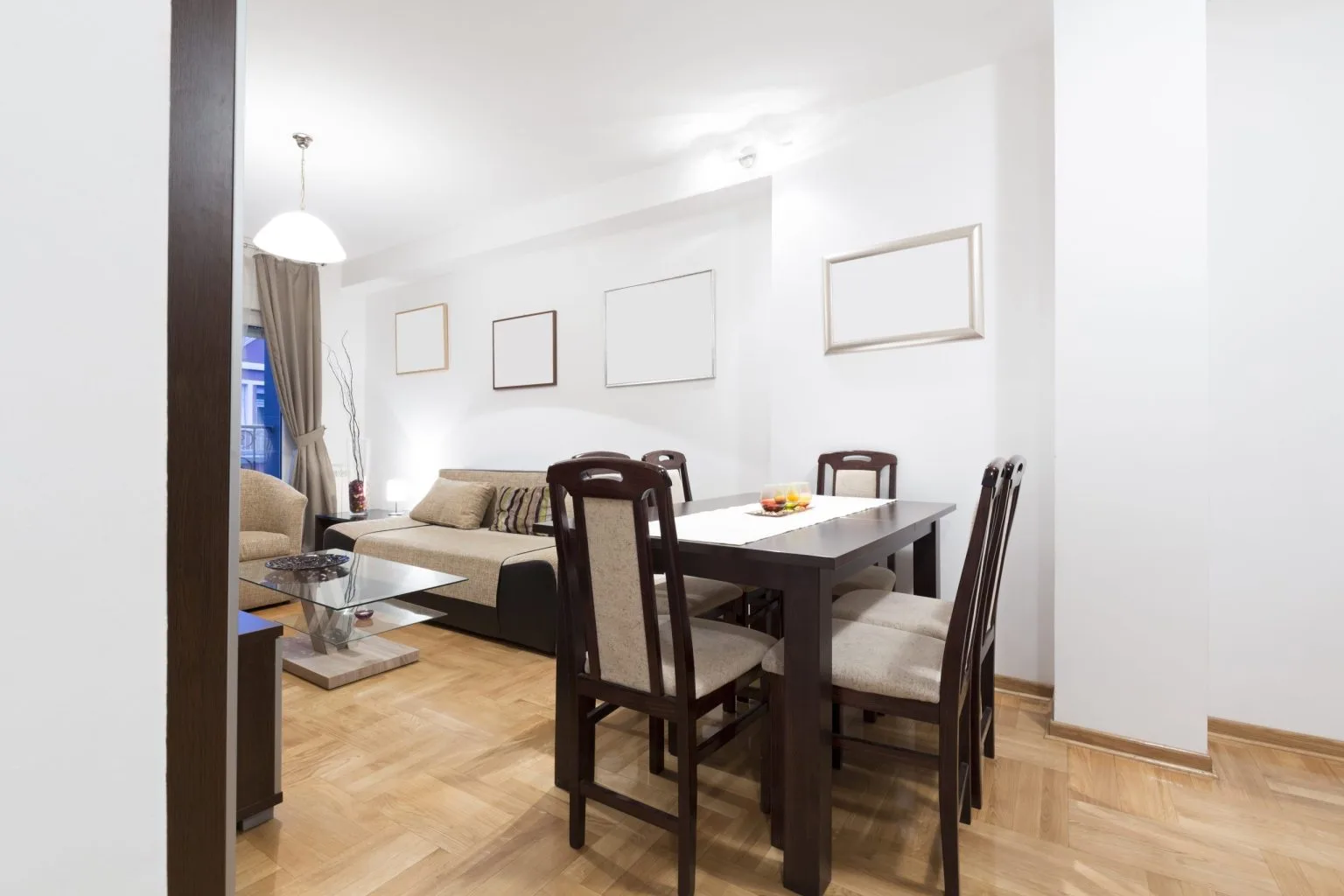
An area rug recess – a shallow inset in the floor build-up where a rug sits flush – is a detail worth asking for while the floor is up. It stops chair legs catching the rug edge, which is the reason most dining rugs end up rolled in a cupboard. It costs almost nothing during a floor replacement and is not possible afterwards.
Painting is the last trade on a dining room renovation in Dubai and the one that shows every shortcut before it. A colour scheme in a dining room can carry more depth than a bedroom, because the room is mostly used in the evening under artificial light – two-tone walls with a deeper band below a dado, or a darker ceiling painting on a high ceiling, both work far better here than they do elsewhere. See painting for systems and preparation.
Kitchen-to-dining layout changes and partitions
Kitchen wall removal is the biggest change you can make on a dining room renovation in Dubai, and the one that needs the most checking first. Going from a closed kitchen to open dining transforms the light and the sociability of a floor, but the wall has to be confirmed as non-structural, the AC return path has to be rethought, and cooking smell now reaches the dining table – which is why many Dubai clients end up with a glass partition rather than an opening.
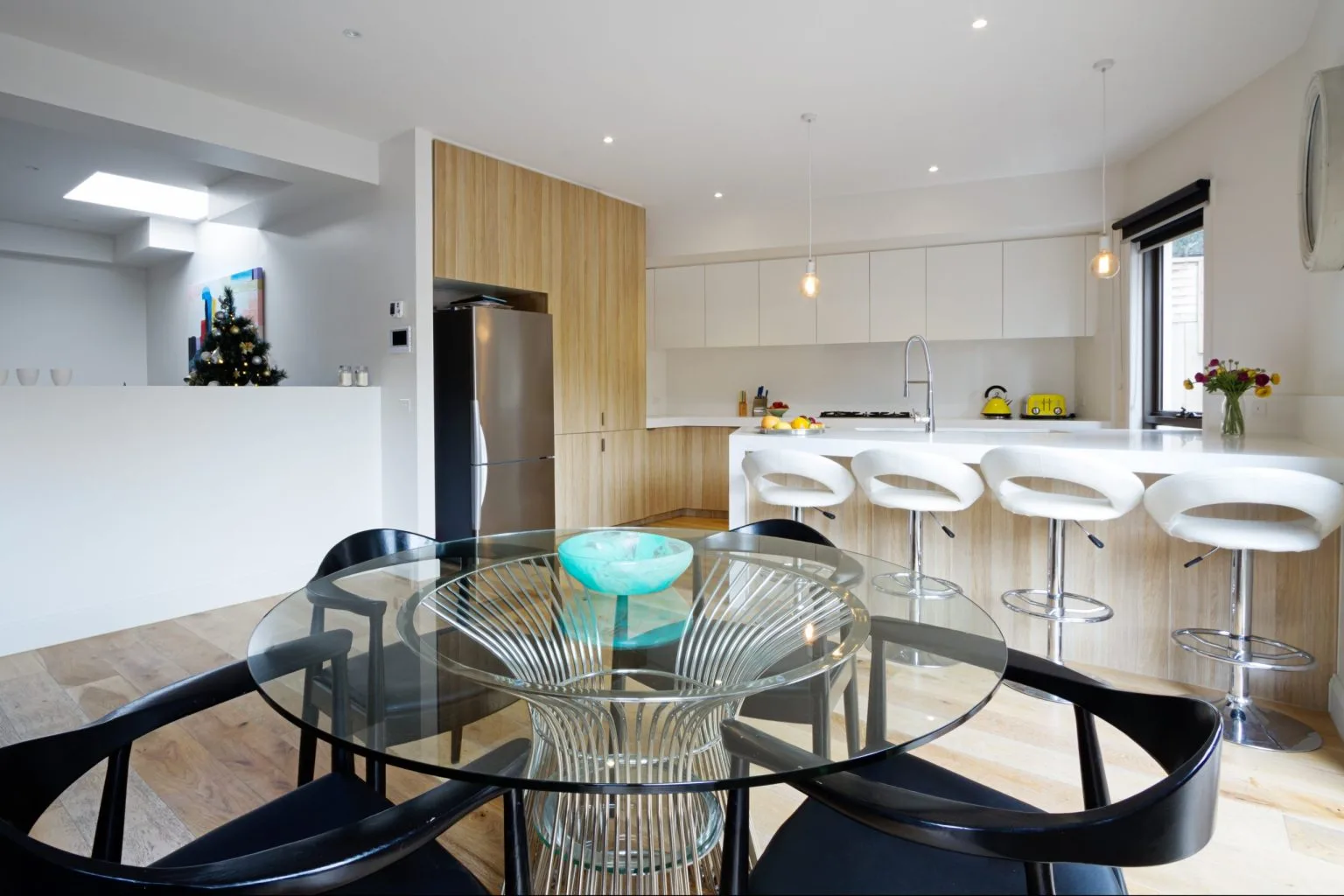
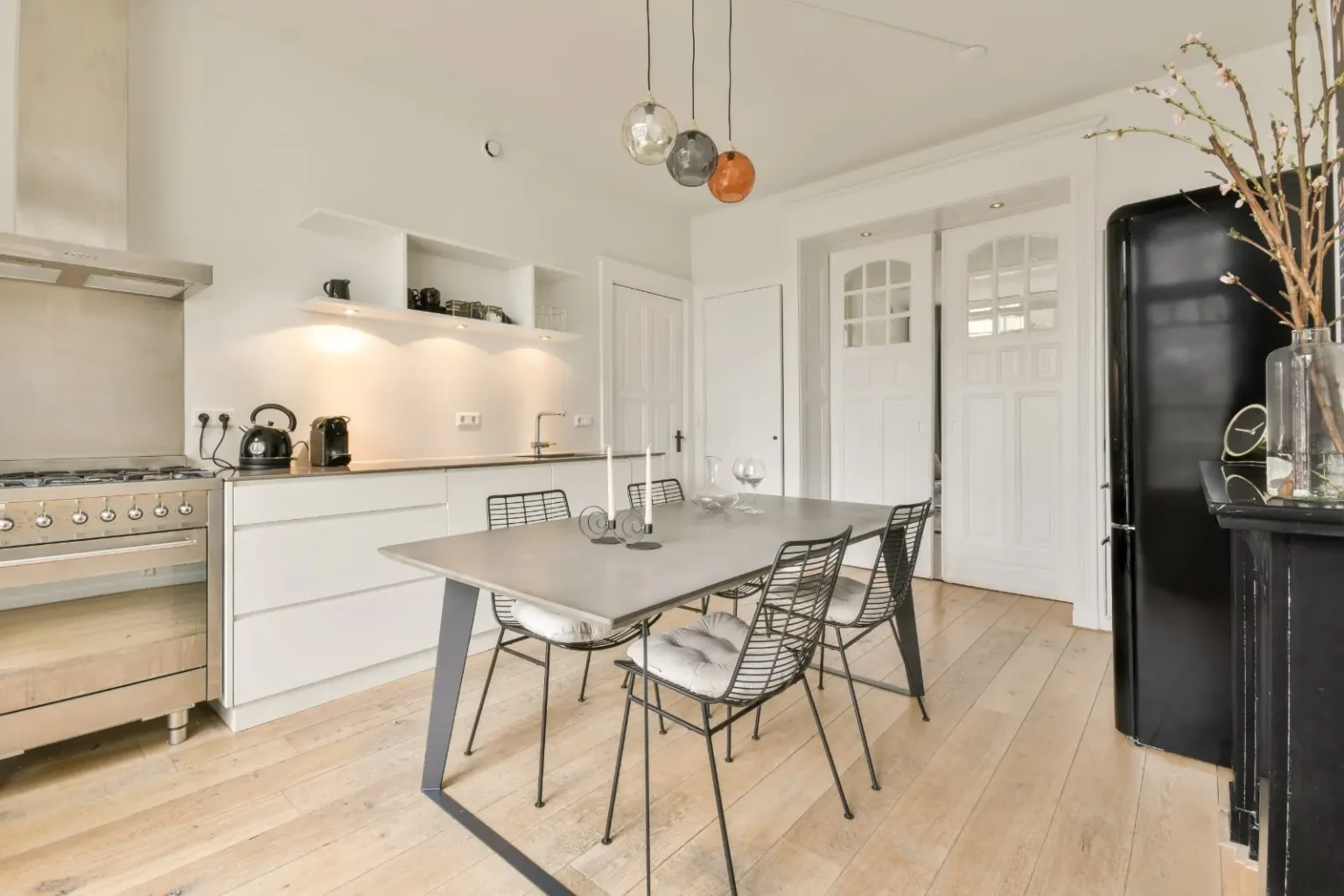
A glass partition between the kitchen and dining room is the compromise that works. Light and sightline pass through; noise and cooking smell mostly do not. A sliding partition or a pair of pocket doors gives you both options on different days, which suits a household that cooks heavily some evenings and entertains on others.
A serving hatch or a pass-through is the lightest intervention of all. Cutting a 900 by 1,200mm opening with a stone or timber sill between a kitchen and a dining room costs a fraction of removing the wall and solves most of the practical problem, which is carrying plates. See partition works and civil works for what each option involves.
Structural changes bring approvals with them. A developer NOC applies in Emaar, Nakheel and Damac communities, building management approval is needed in almost every tower, landlord permission is required in writing if you rent, and a Dubai Municipality submission is needed for any wall removal. We prepare the drawings and lodge the submission; authority fees are charged at cost.
Doors and openings deserve the same thought as walls. Pocket doors disappear entirely, glass doors keep the light, double doors suit a formal room and an arched opening softens the transition without a door at all. See door services for cores, frames and ironmongery.
Majlis and dining room combination
Majlis and dining sit next to each other in most Dubai villas and the relationship between them decides how the ground floor works. A majlis renovation on its own is mostly seating, lighting and wall treatment, and a dining room renovation in Dubai alongside it changes the whole floor; done alongside the dining room it becomes one continuous scheme, which is cheaper per room and looks considerably better than two schemes that nearly match.
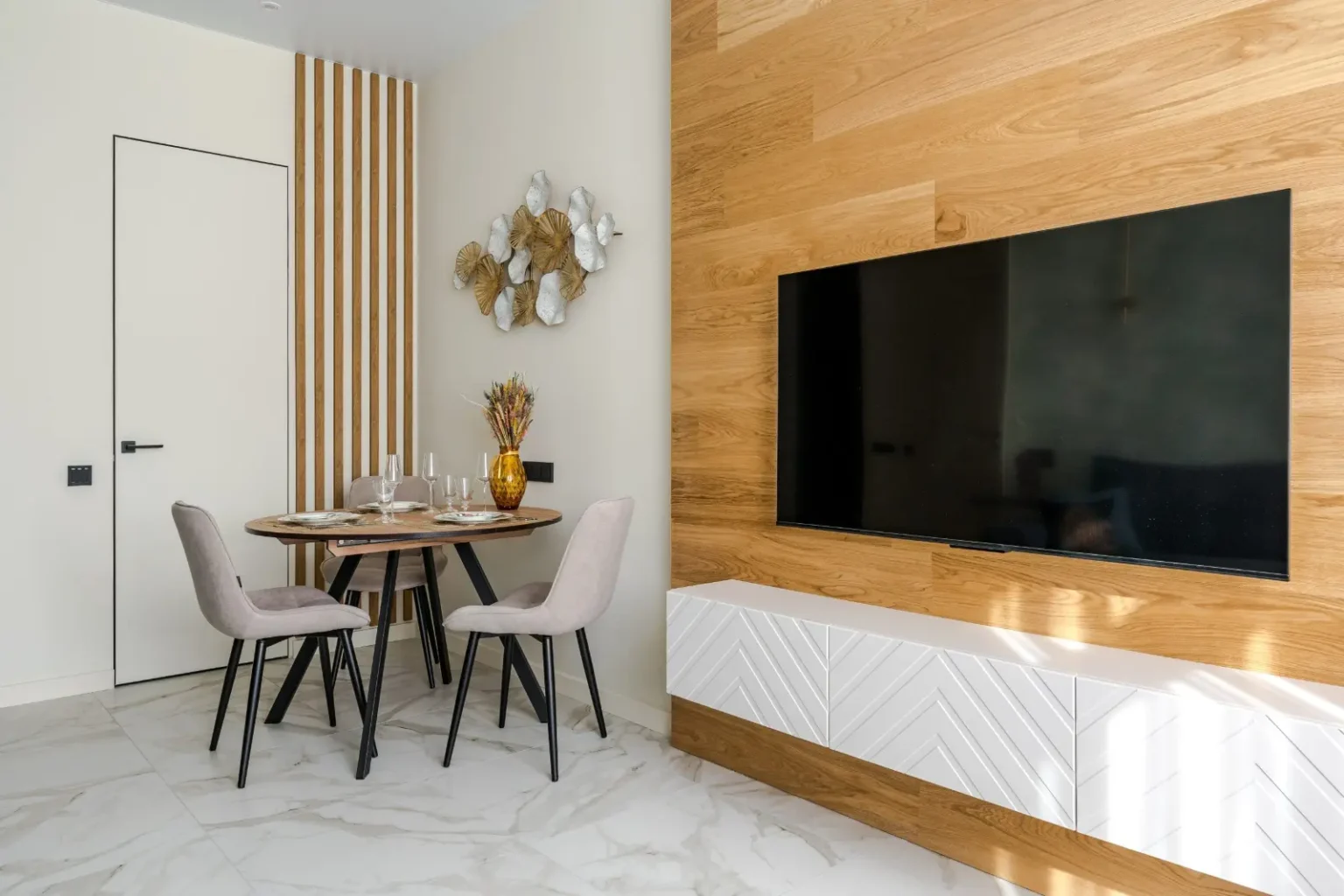
A formal majlis usually wants built-in seating around the perimeter, a deeper seat than Western furniture, and a lighting scheme that works for a room full of people rather than four. We build majlis seating as joinery with upholstered cushions, so the bases give you storage and the covers can be changed later without replacing the furniture.
A dining and majlis partition is worth getting right. Sliding doors between the majlis and the dining room let you run them as one space for a large gathering and close them for a quiet dinner. A slatted timber screen, a glass partition or a run of low joinery all divide the two without committing to a wall, and all three are reversible.
Villa and apartment dining room fit-out
A villa dining room renovation in Dubai usually covers a separate room with a door, often adjoining the majlis, and nearly always the room with the highest ceiling. That height is an opportunity – a tall panelled wall, a long chandelier drop and a tray ceiling all need it. Townhouse dining is normally part of an open-plan ground floor, so the zoning work matters more than the finishes.
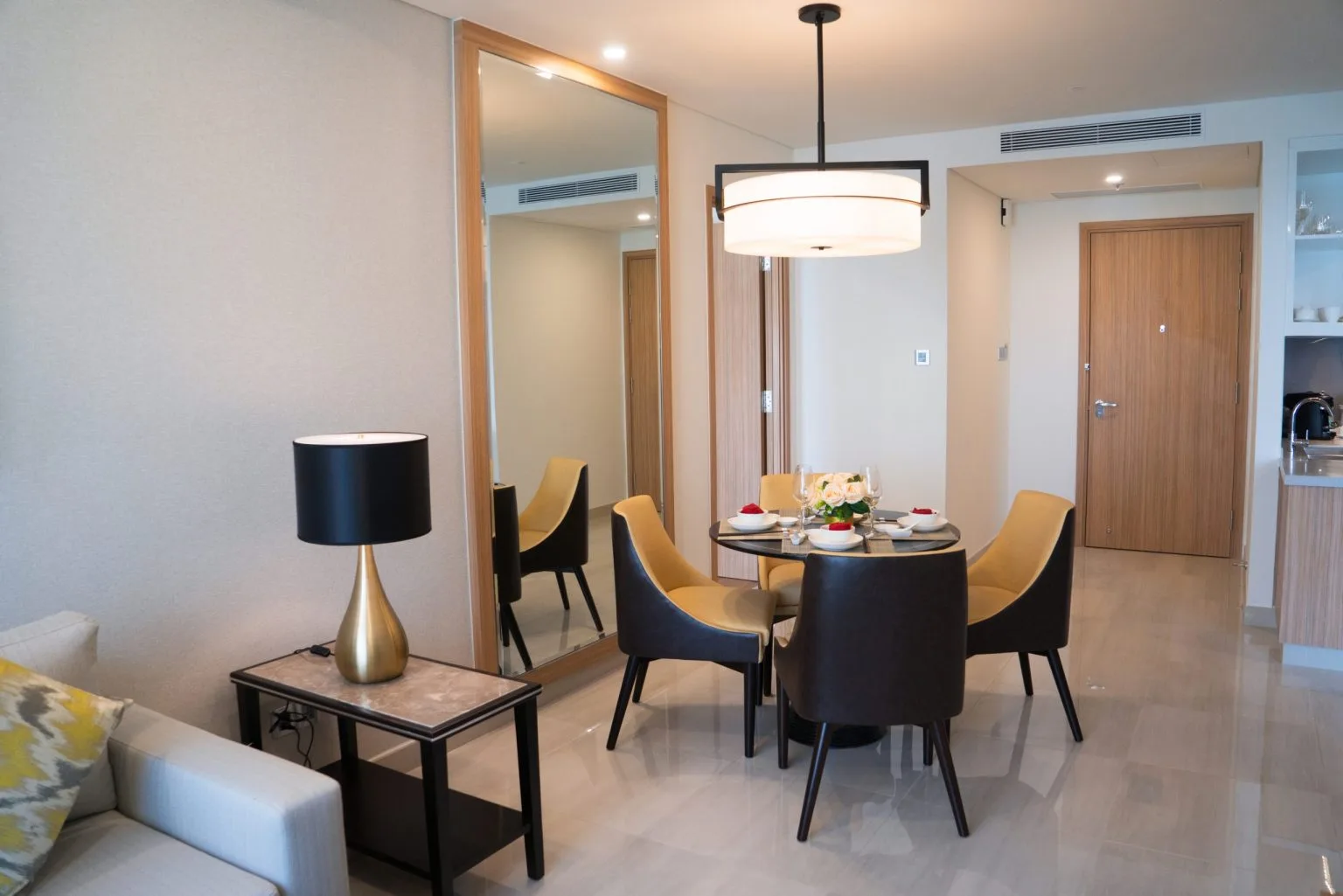
An apartment dining area is a space-planning problem. A round table seats more people in less floor area than a rectangular one and removes the corner you always walk into. Penthouse dining goes the other way entirely, with the room sized for a long table and the view doing most of the work. We cover Dubai Marina, Downtown, Business Bay, JVC, Dubai Hills, Arabian Ranches, Damac Hills, Springs, Meadows, Mirdif, Palm Jumeirah and Jumeirah.
Storage solutions matter more in an apartment than in a villa. Hidden storage behind a flush panel in the feature wall, a dining-to-pantry link where the two rooms share a wall, and a serving station built into the sideboard all buy space back. In a villa the same thinking usually goes into a dedicated serving run between the kitchen and the dining room.
Window treatments finish the room. Dining room curtains with a lined pelmet or a recessed curtain box built into the ceiling hide the track and stop light leaking above the curtain, and that box has to be formed while the ceiling is open. Blinds suit a dining area beside a kitchen where fabric would hold cooking smell. Dining room AC is the other ceiling item – diffuser relocation and ceiling AC grilles are planned with the ceiling, not after it, and our HVAC team sets the duct route before the ceiling frame goes up.
Restaurant and hotel dining fit-out
A restaurant dining area fit-out is a different trade from a home dining room renovation in Dubai even though the items look similar. Everything is specified for commercial use and for the speed of a future repair: fixed banquette seating for F&B in wipe-clean vinyl or contract-grade fabric, table bases bolted down, finishes that survive a bleach wipe, and edges detailed so a trolley does not destroy them in month two.
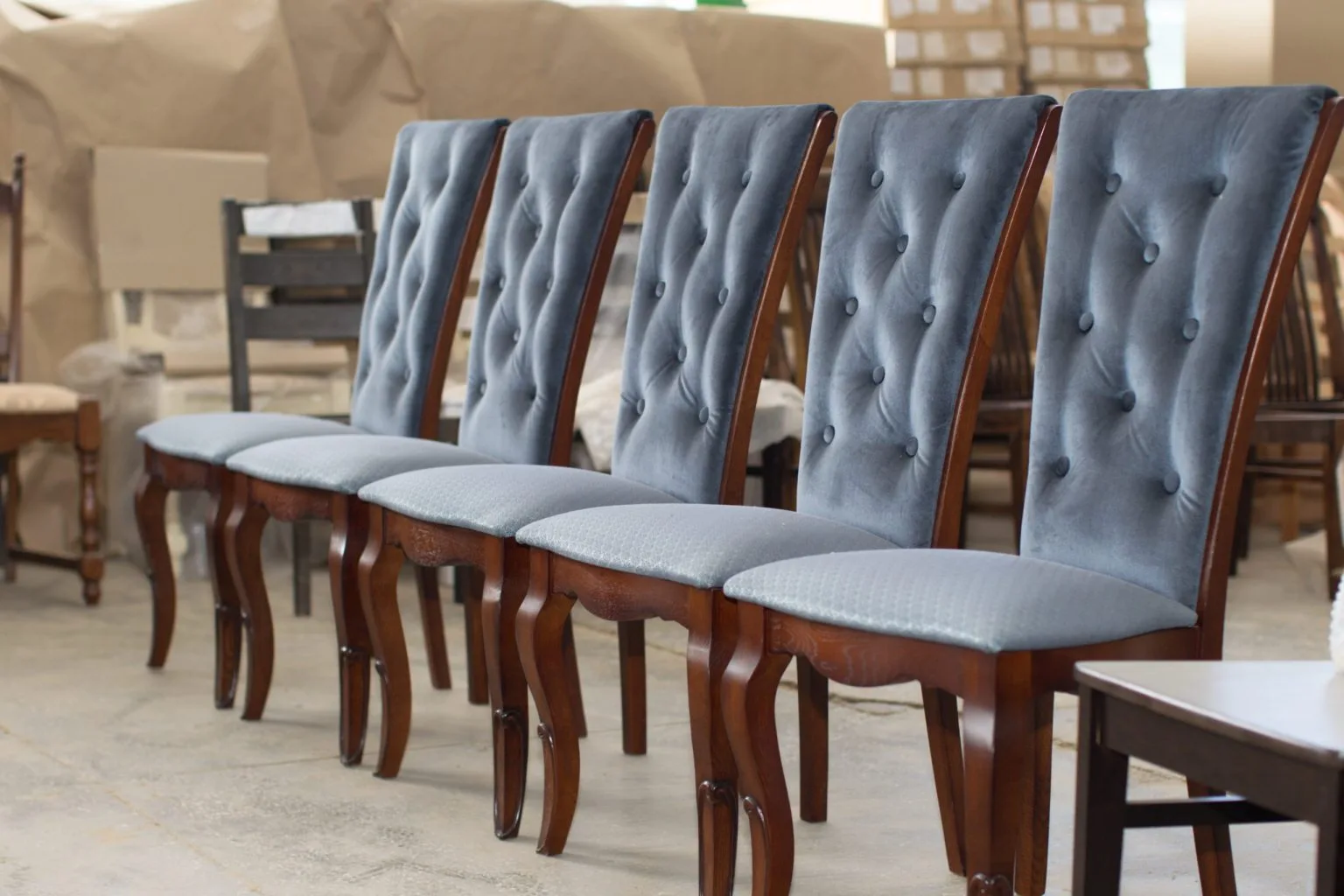
A hotel dining room and a private dining room, or PDR, both need a scheme that photographs well and runs quietly. Acoustic treatment matters more in a restaurant than any finish – a beautiful hard-surfaced room that nobody can hold a conversation in is a commercial failure. Panelling with an acoustic backing, upholstered banquettes and a treated ceiling are where that is solved.
Cafe seating is usually about turnover and maintenance. Fewer parts, replaceable seat pads, and a table top you can refinish rather than replace. We build and reupholster in our own workshop, which means a damaged banquette panel can be remade to match rather than the whole run being replaced.
Commercial jobs are quoted against a BOQ or a drawing pack rather than a site photo, and we work out of hours in trading premises when the client needs it, phasing areas so a floor is never entirely out of service.
How a dining room renovation in Dubai runs
A dining room renovation in Dubai runs as five stages. A finishes refresh compresses them; a full room with bespoke joinery does not skip any. The timings below assume one occupied home, with the family staying in the property throughout.
Survey and measure
We measure the room and check each service.
Design and approve
You sign off the 3D designs and elevations.
Workshop and spray
We machine and spray every panel ourselves.
Ceiling and wiring
We rework the ceilings, lights and sockets.
Install and finish
We fit, paint, snag and clean before we go.
A dining room renovation timeline is one to two weeks on site for a full room and two to four days for a 1–2 week dining room makeover that is paint, lighting and a feature wall. Manufacturing runs three to four weeks before either, and we start that clock the moment the elevations are approved so the disruptive part of the job stays short.
Who sets the rules and makes the board
A finishes-only dining job needs little more than building management approval. The moment a wall moves, these are the bodies involved – and the last one makes the panels most of this joinery is built from.
Dining room renovation cost in Dubai
Dining room renovation cost in Dubai is driven by joinery and lighting. The table, the cabinetry run and the feature wall account for most of the number; flooring and paint move it far less. The ranges below are the ones we quote, taken from our own completed projects, and they cover supply, delivery and installation by our fitters.
Dining room renovation in Dubai: price guide
| Item | Unit | Typical range |
|---|---|---|
| Dining room refresh, finishes and lighting | per room | AED 15,000 – 40,000 |
| Full dining room with bespoke joinery | per room | AED 40,000 – 140,000 |
| Bespoke dining table, solid timber | each | AED 9,000 – 35,000 |
| Bespoke dining table, veneered | each | AED 6,500 – 18,000 |
| Dining table with stone top | each | AED 12,000 – 45,000 |
| Extending mechanism, added | each | AED 1,800 – 5,500 |
| Sideboard or buffet unit | per linear m | AED 3,200 – 8,500 |
| Full-height crockery and display unit | per linear m | AED 4,000 – 11,000 |
| Dining chairs, upholstered, per chair | each | AED 850 – 3,200 |
| Reupholstering existing dining chairs | each | AED 280 – 750 |
| Wall panelling | per sq m | AED 450 – 1,100 |
| Built-in banquette or majlis seating | per linear m | AED 900 – 2,400 |
| Pendant or linear lighting, installed | each | AED 650 – 4,500 |
| Flooring, engineered timber or stone | per sq m | AED 180 – 650 |
A dining room renovation in Dubai at AED 15,000 to 40,000 buys finishes and lighting – panelling or paint, a new ceiling detail, a pendant or chandelier and flooring. A full room with bespoke joinery is AED 40,000 to 140,000 and includes the table, the cabinetry and the seating. Dining cabinet cost is quoted per linear metre so you can compare: AED 3,200 to 8,500 for a sideboard and AED 4,000 to 11,000 for a full-height crockery and display unit.
Feature wall cost is AED 450 to 1,100 per square metre in panelling, which makes a typical 4 by 3 metre dining wall AED 5,400 to 13,200. Two items move a quotation more than the rest. The first is the table – a veneered top and a stone top of identical size can differ by AED 30,000. The second is whether a wall comes out, because that turns a joinery job into a civil works job with a submission attached.
Dining room renovation in Dubai: 12 best expert answers
How much does a dining room renovation cost in Dubai?
A finishes-and-lighting refresh is AED 15,000 to 40,000 – panelling or paint, a ceiling detail, a new light over the table and flooring. A full room with bespoke joinery is AED 40,000 to 140,000 and includes the table, the cabinetry run and the seating. The table alone ranges from AED 6,500 veneered to AED 45,000 with a stone top, which is usually the single biggest variable in the quotation.
How much does a dining feature wall or dining cabinet cost?
Wall panelling is AED 450 to 1,100 per square metre, so a typical 4 by 3 metre dining wall is AED 5,400 to 13,200 depending on profile and finish. A sideboard or buffet unit is AED 3,200 to 8,500 per linear metre and a full-height crockery and display unit is AED 4,000 to 11,000 per linear metre. A mirrored wall is priced on glass area and edge treatment – antique and bronze mirror cost more than plain.
Can I open my closed kitchen into the dining room in a Dubai apartment?
Sometimes, and it has to be checked rather than assumed. The wall must be confirmed as non-structural, building management has to approve the works, a developer NOC applies in Emaar, Nakheel and Damac buildings, and Dubai Municipality consent is needed for any wall removal. If you rent, the landlord has to agree in writing. Where the wall cannot come out, a serving hatch or a glass partition gives you most of the benefit for a fraction of the cost and paperwork.
How long does a dining room makeover take?
Two to four days for paint, lighting and a feature wall. One to two weeks on site for a full room with new joinery, ceiling and flooring. Behind both sits three to four weeks of manufacturing between approving the elevations and the joinery arriving, so the total from first visit to finished room is usually five to seven weeks even though the disruptive part is short.
Do I need to move out while you work?
No. A dining room has no wet trades, so we seal the doorway, protect the route and work with dust extraction. The genuinely disruptive days are the ceiling and wiring day and the flooring day. If a wall is being removed that changes – expect noise and dust for two to three days and plan to be out during them.
Can you make a dining table to match the cabinetry?
That is the usual request and the reason to use a joinery company for this room. The table, the sideboard and the panelling are made from the same board batch and sprayed in the same run, which is how the colour matches across the room. Solid timber, veneer and stone tops are all made to size, and an extending mechanism can be built in at AED 1,800 to 5,500.
Is a mirror wall a good idea in a dining room?
In a narrow or internal room, yes – it doubles the apparent width and reflects the chandelier. The usual objection is watching yourself eat, which antique or bronze mirror solves by softening the reflection. Avoid plain mirror directly opposite a seat, and keep the panel joints aligned to the table so the reflection reads as deliberate rather than as a mistake.
What height should the pendant over the dining table be?
750 to 850mm above the tabletop. Lower and it blocks the sightline across the table; higher and it stops lighting the food and starts lighting the room. The other point people miss is that the fixing has to go over the centre of the table, not the centre of the room – the two are rarely the same, and the backing must be fixed to the slab before the gypsum ceiling closes.
Can you build banquette or majlis seating?
Yes, and it is usually better value than loose furniture. Built-in banquette and majlis seating is AED 900 to 2,400 per linear metre, gives you storage in the base, and buys back two chair-widths of floor in a tight room. We build the carcass in the workshop and upholster it ourselves, so covers can be changed later without replacing the seating.
Can you reupholster my existing dining chairs instead of replacing them?
Often the better call. Reupholstering is AED 280 to 750 per chair against AED 850 to 3,200 for a new upholstered chair, and an older frame is usually better made than a new one at that price. We strip, repair and refinish the frame as well as recovering the seat, so the chair comes back sound rather than just re-skinned.
Do you handle the ceiling, lighting and flooring too?
Yes. Gypsum ceilings, first-fix wiring and dimmers, flooring and painting are all in-house alongside the joinery, which is why the sequence holds together. In a dining room that matters more than usual, because the chandelier fixing, the cove detail and the AC diffuser positions all have to be settled before the ceiling closes.
Which areas of Dubai do you cover?
Dubai Marina, Downtown, Business Bay, JVC, Dubai Hills, Arabian Ranches, Damac Hills, Springs, Meadows, Mirdif, Palm Jumeirah and Jumeirah, plus most towers and villa communities in between. The workshop is in Ras Al Khor Industrial Area 2, which keeps deliveries of long table tops and panel runs practical across the city.
Send a photo and the room size
WhatsApp a photo of the dining room and the wall you want changed, with rough dimensions and how many people you need to seat, and we will come back with an indicative range the same day. A free site visit and a written dining room quotation follow if the numbers work for you.