False ceiling and gypsum works in Dubai, set out around the light
The ceiling is drawn before it is framed. Lighting layout, AC grilles, access panels and the drop are all agreed on one drawing — then framed, boarded, skimmed and painted by our own team from Ras Al Khor.
False ceiling Dubai
A false ceiling Dubai apartments and villas need is a gypsum board ceiling hung on a galvanised metal frame, dropped far enough below the slab to take the ducting, the wiring and the lighting, then skimmed and painted flat. Flat gypsum runs AED 45 to 60 per sq ft supplied and installed. Abdulla Carpentry EST has been doing this since 1984.
Almost every complaint we are called about on ceiling works Dubai owners have already paid for comes down to one thing: the ceiling was framed before the lighting was decided. Then the spotlights land wherever the joists allow, the cove runs out of room in one corner, and the AC grille ends up 90 mm off the centre line of a room everybody looks up at.
So we do it the other way round. The reflected ceiling plan — every downlight, cove, grille, detector, speaker and access panel — is drawn and approved before a single channel is cut. That drawing is what the framers work to, and it is why our ceilings look deliberate rather than improvised.
That is the difference between false ceiling contractors Dubai clients hire by the square foot and a company that employs its own framers, boarders, plasterers, painters and electricians. Our gypsum works Dubai teams are on our own payroll, so the man who sets the level is the man who answers for it. We are not gypsum contractors who subcontract the second half of the job.
 From AED 45Per sq ft, flat gypsum
Gypsum ceiling design
A ceiling design is a drawing problem before it is a building one. Get the module right and the room reads calm; get it wrong and no amount of lighting rescues it.
A gypsum board ceiling — the same thing a plasterboard ceiling means — is 12.5 mm board screwed to a galvanised furring and main-channel frame, hung on adjustable hangers off the slab. The frame is what matters. Channels at 400 or 600 mm centres, hangers at 900, joints staggered and never landing on a corner of an opening. That is what stops the cracking you see in ceilings that were built to a price.
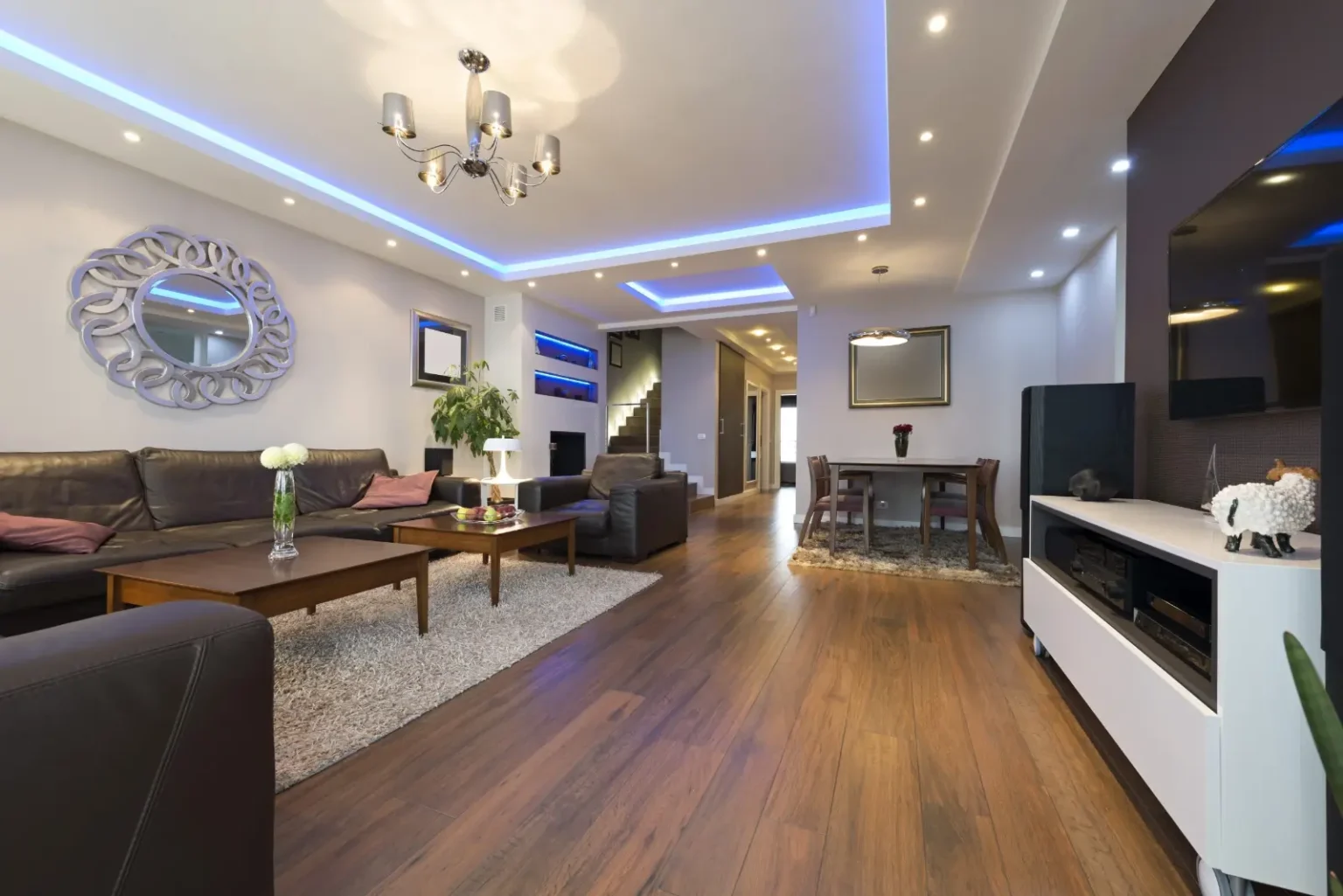
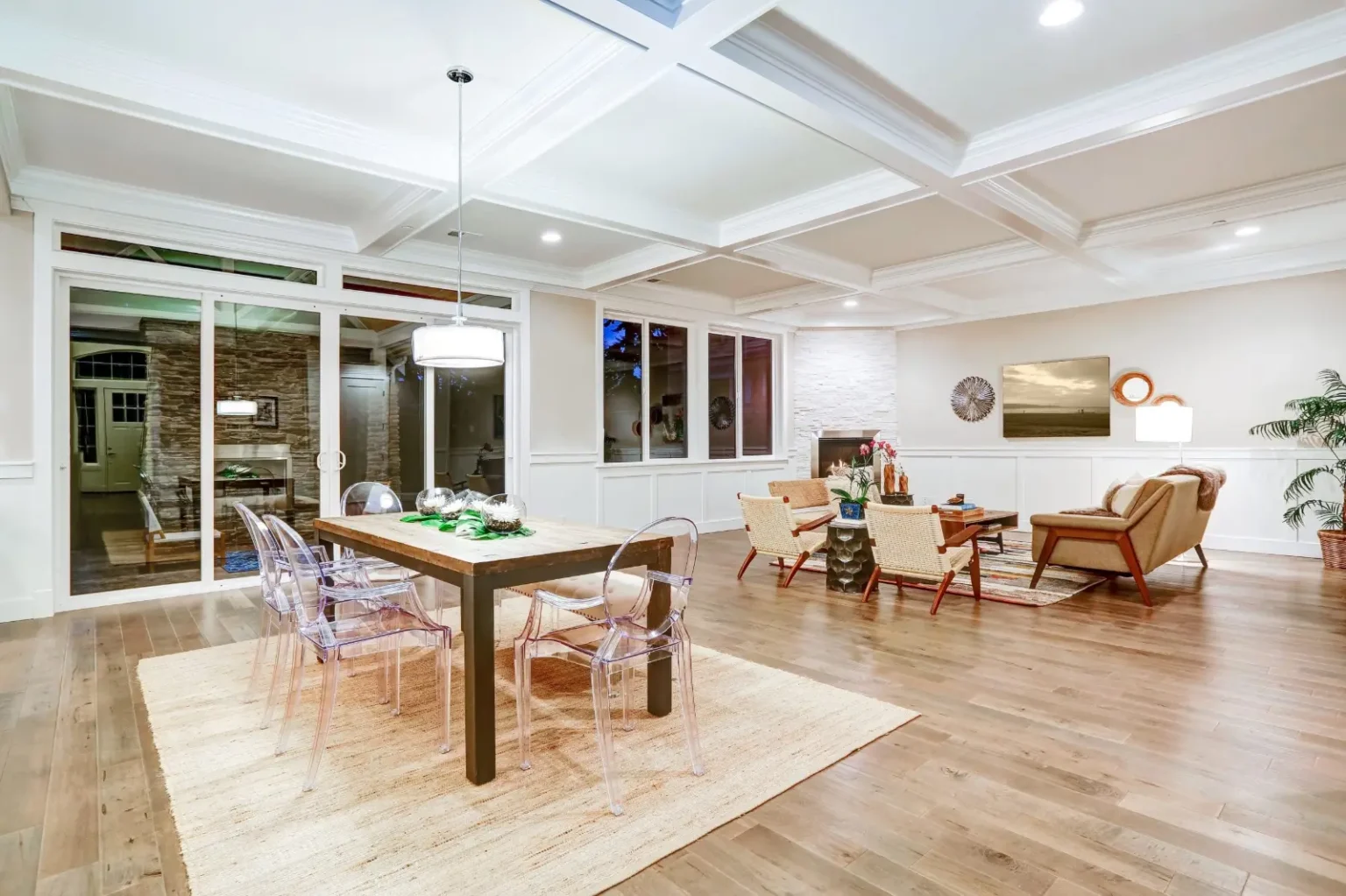
For a false ceiling design for living room spaces we usually set a perimeter drop with a cove, so the light washes the flat middle instead of dotting it with spots. In a bedroom the drop goes over the bed rather than the whole room, which keeps head height where you notice it and gives a soft light where you want it. In a hall or corridor we keep it flat and let the lighting do the work — a stepped ceiling in a 1.2 m wide corridor just makes it feel narrower.
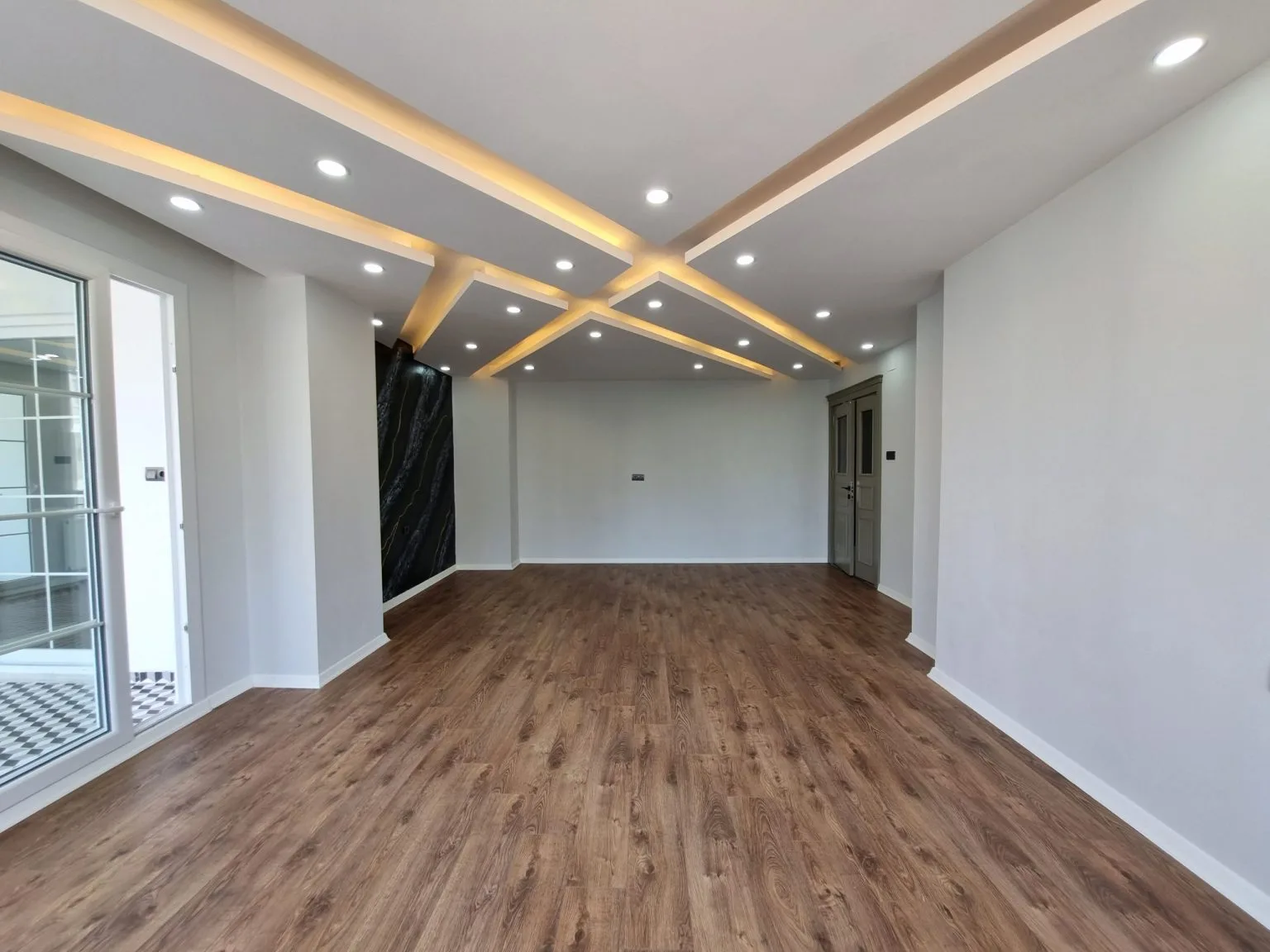
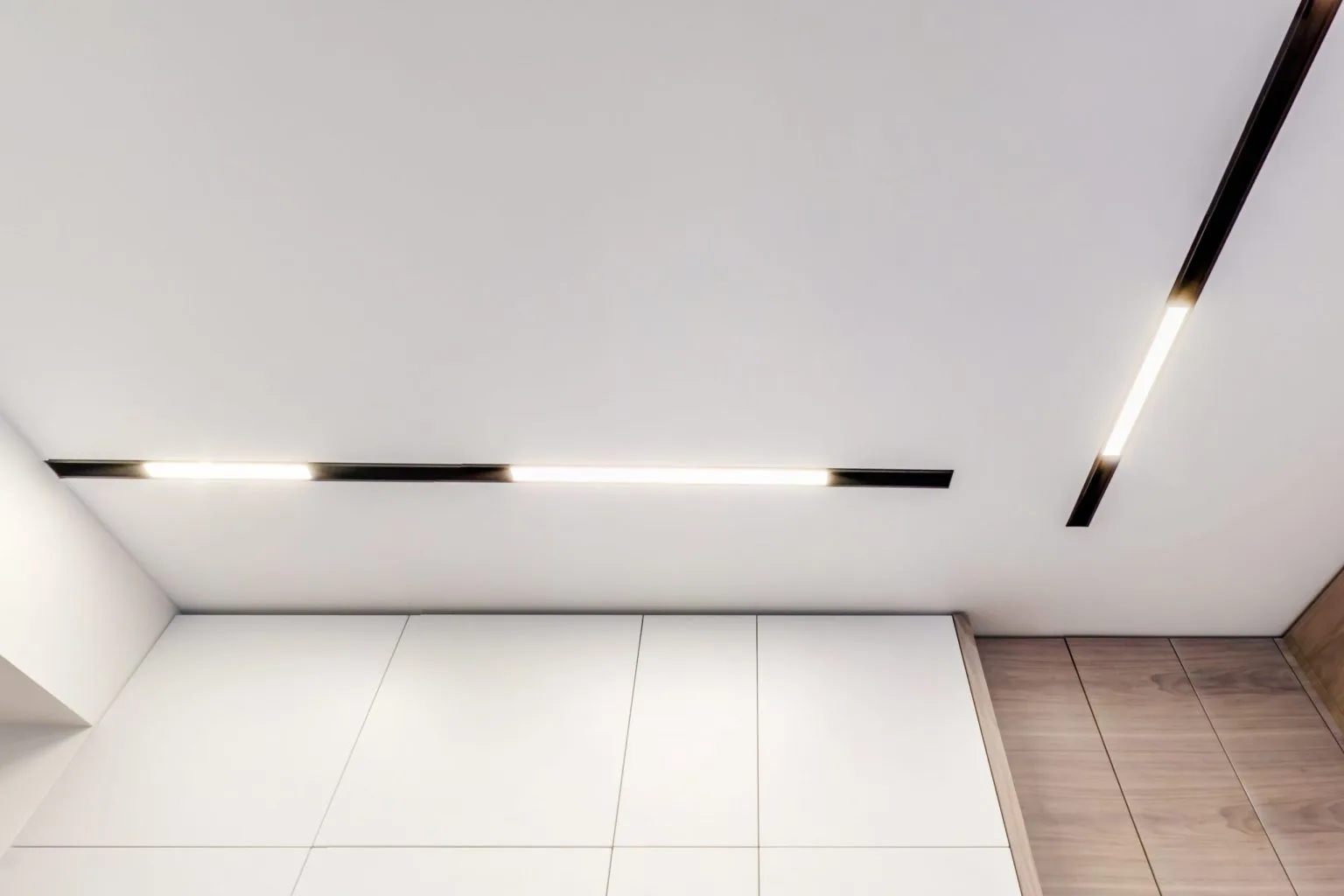
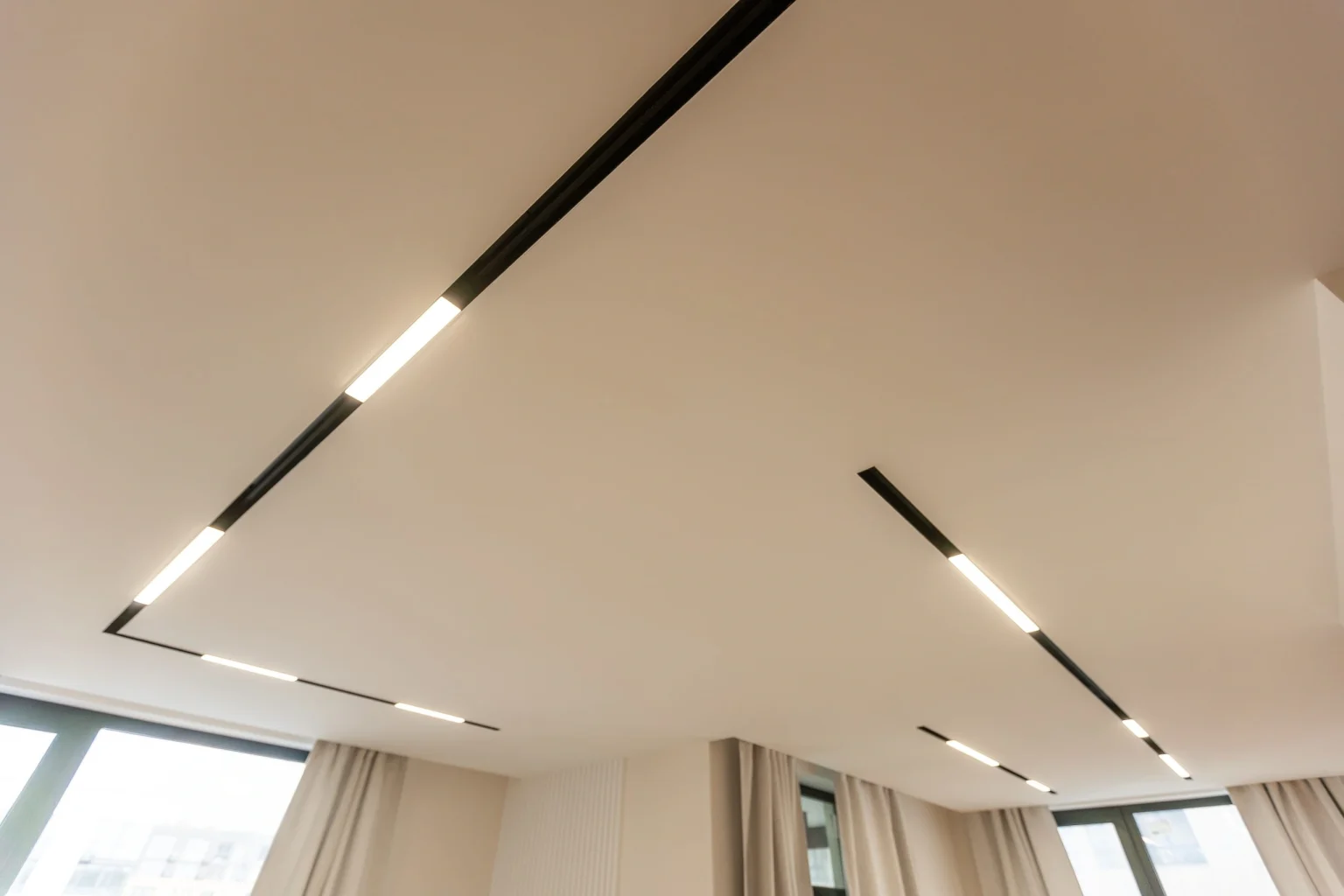
A modern false ceiling design in Dubai right now means fewer levels, not more: one clean drop, a deep shadow gap, a linear light instead of a row of spots. A simple false ceiling design is genuinely the harder one to build well, because there is no busy detailing to hide a wavy line — which is exactly why we laser-level the frame rather than string-lining it.
We also build gypsum partition walls with the same frame system, and often in the same visit: a stud partition to close off a store, split a room or box in a riser, insulated where sound matters and fire-rated board where the building requires it.
Cove lighting and LED ceiling design
Nobody looks at a ceiling. They look at the light coming off it — which is why the cove profile matters more than the ceiling shape.
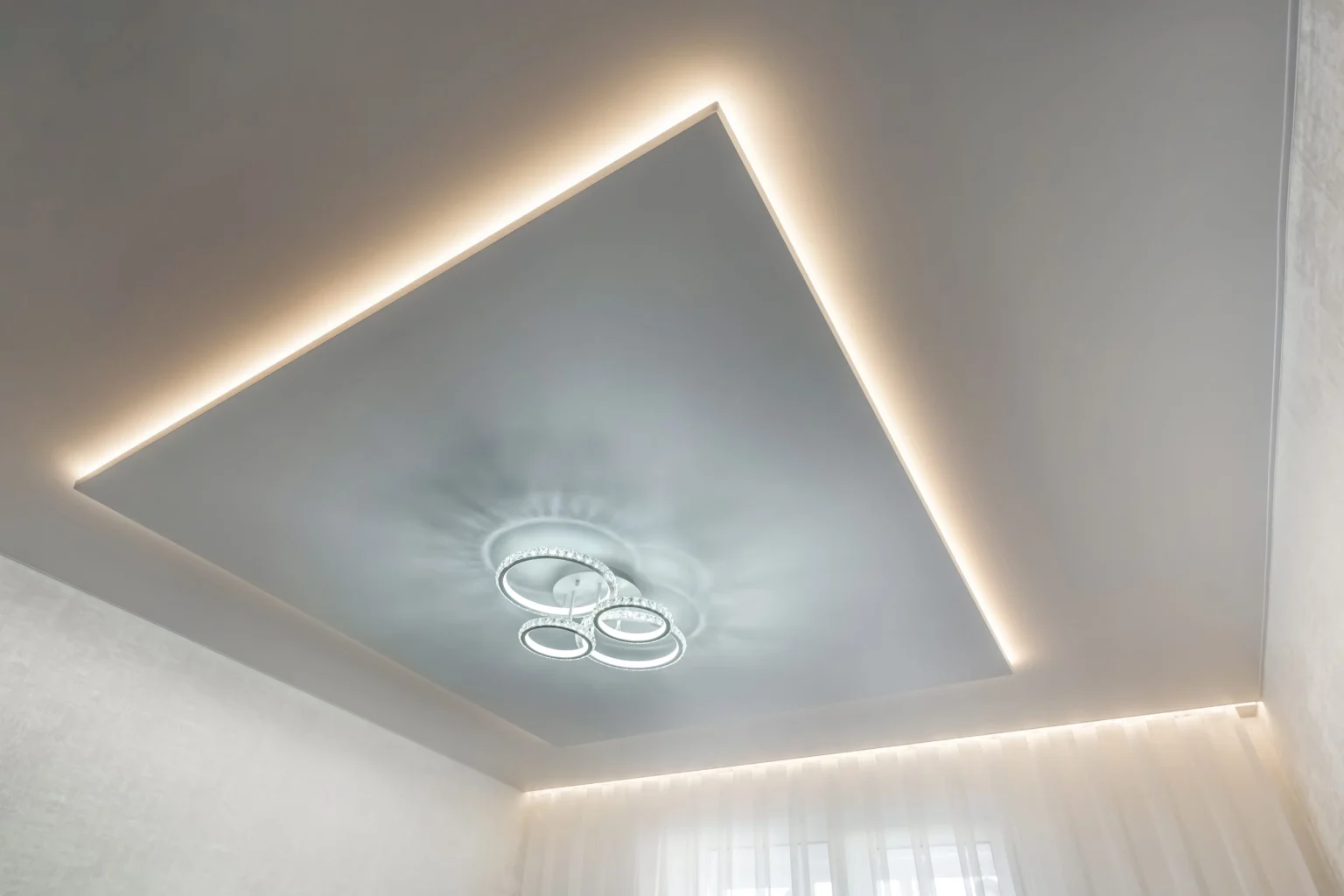
A cove light ceiling works by bouncing light off the slab above so the room is lit without a visible source. The detail that makes or breaks it is the lip: too shallow and you see the strip reflected as a bright line, too deep and the light never escapes. We build the cove at least 120 mm deep with a 50 mm upstand, and we mock it up on site before boarding when a client is unsure.
Indirect lighting is the whole point of the exercise. A room lit only by downlights is a room full of scallops and shadows under the eyes; the same room with a cove and two downlights reads calm. We would rather talk a client out of eighteen spots than install them.
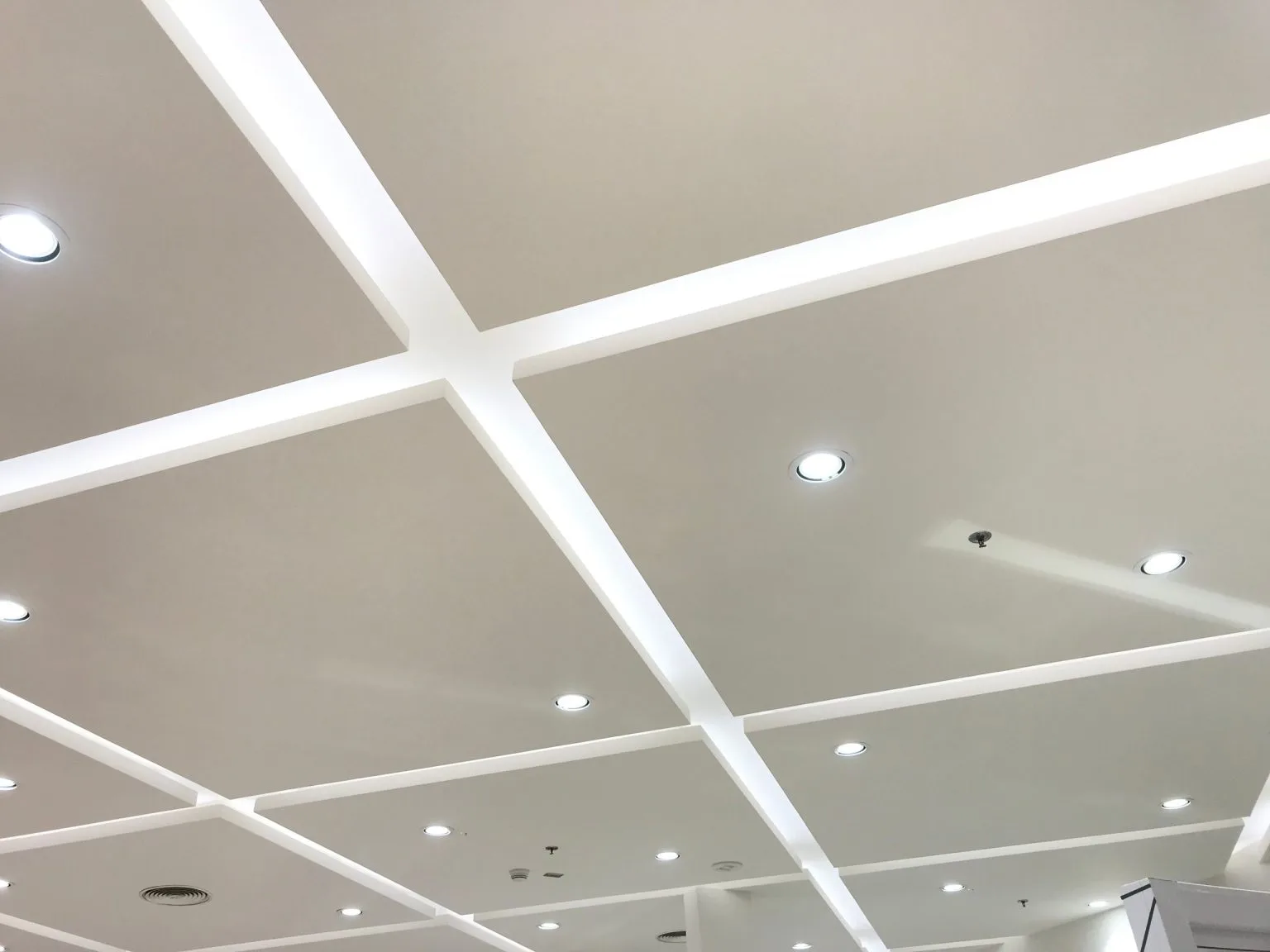
For LED strip lighting we specify a proper aluminium profile with a diffuser rather than a bare tape stuck to raw board, because a bare strip shows every dot and the adhesive fails in the heat inside a ceiling void. Driver location is decided at first fix and left accessible — a driver buried behind a skimmed ceiling is a demolition job three years later.
Spotlights and downlights get the same honesty. Cut-outs are set out on the drawing, not eyeballed on the board, and we hold them off the walls far enough to wash rather than graze. Ceiling lighting layout is a service we do properly: we mark the ceiling, walk it with you before any hole is cut, and change it on the board rather than after the electrician has pulled the cable.
Five stages, in this order
One team from the drawing to the paint. Nothing is framed before the lighting plan is signed off, because that is the mistake that cannot be undone later.
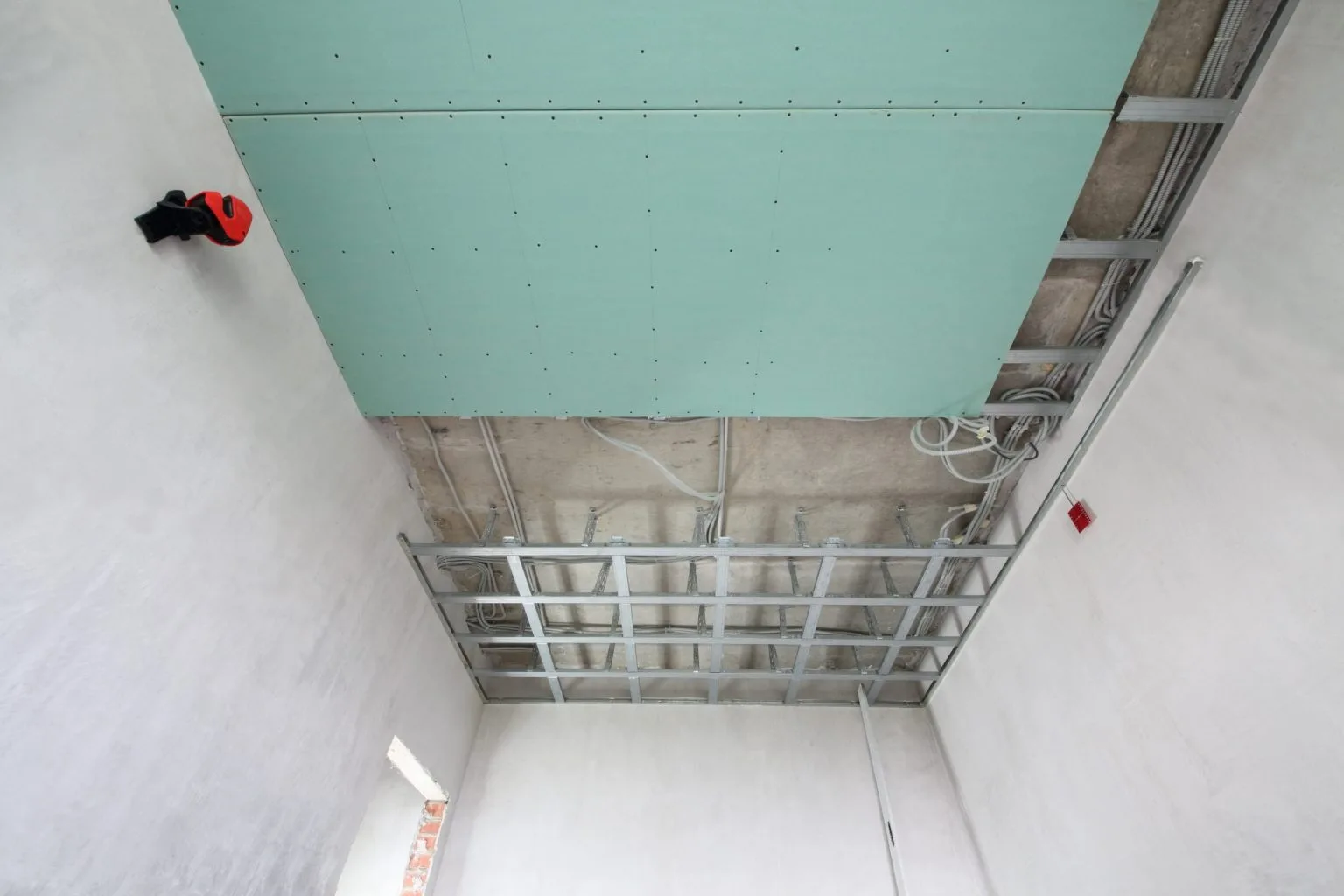
Survey and ceiling plan
We measure the void, locate the services, then draw every light, grille and panel for you to sign off.
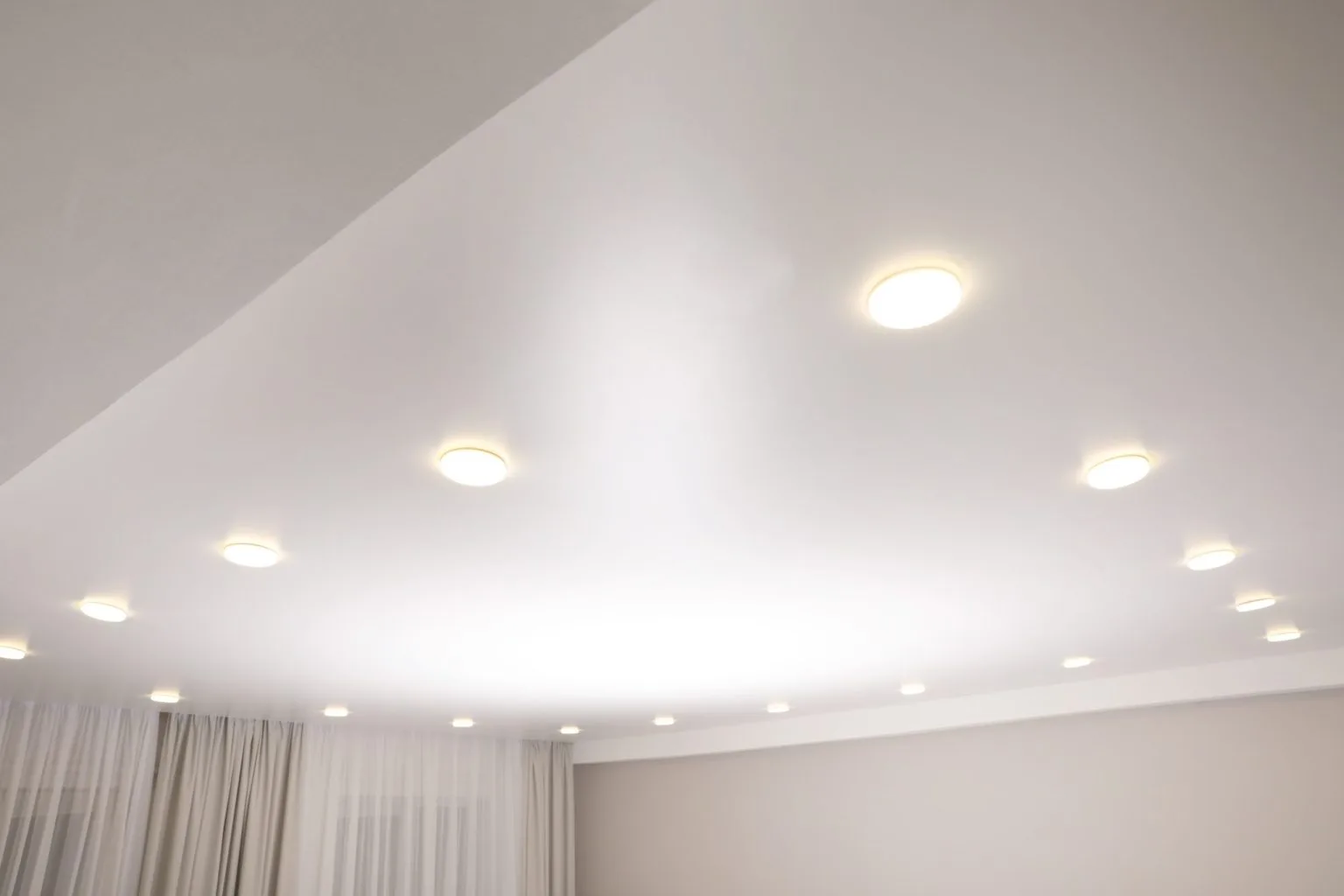
Framing, laser-levelled
Hangers and channels go up to the drawing, levelled by laser so the finished plane is genuinely level.
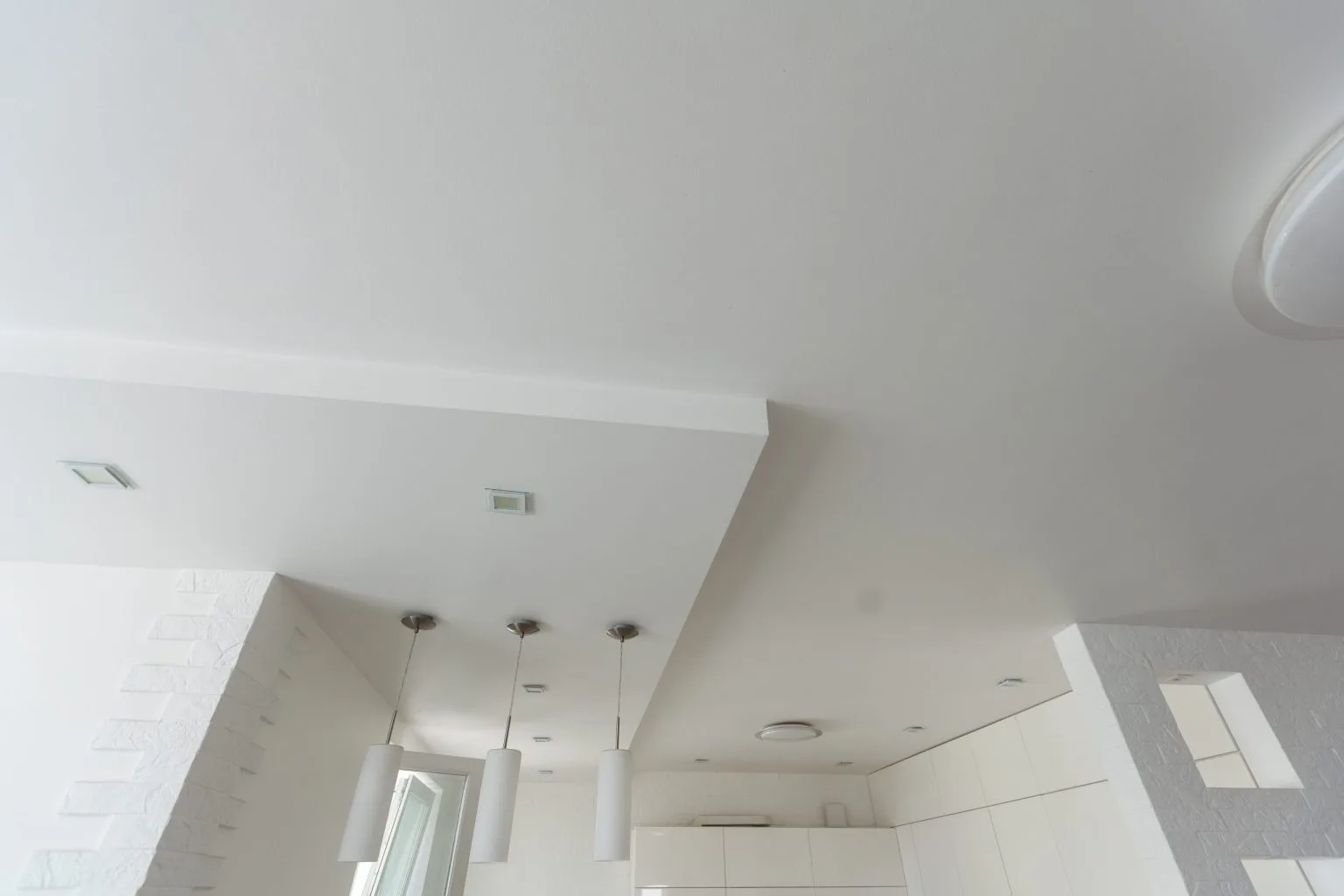
Boarding and bulkheads
Board is fixed with staggered joints, the bulkheads formed, and access panels cut where the plan says.
Taping, skim and cut-outs
Joints are taped in three passes, the ceiling is skimmed, then light cut-outs are made to the drawing.
Paint, lighting and handover
Two coats of matt go on, fittings are set and tested, then we snag the ceiling and hand the room over.
Approvals sit alongside all of this. Most apartment ceiling work needs Dubai Municipality or building management approval for ceiling works before anything starts, and more so where sprinklers, detectors or fire-rated construction are touched. We prepare the drawings and submit the paperwork as part of the job, and we obtain the NOC per project rather than claiming any standing approval we do not hold.
Living room, bedroom and kitchen ceilings
Three rooms, three different problems. The living room is about proportion, the bedroom about glare, the kitchen about extraction.
In a living room the bulkhead ceiling earns its keep. A perimeter drop of 250 to 400 mm hides the AC duct that runs round the slab edge, gives the cove somewhere to live, and frames the flat centre so the room reads taller than it is. Where the whole ceiling has to come down — a low slab, a lot of services — a full drop ceiling is the honest answer, and we will tell you at survey how much height you will lose before you commit.
Bedrooms are about what you see lying down. No downlight goes directly over the bed, the cove carries the ambient light, and we add a dimmable circuit and a low-level night light on a separate switch. If a ceiling fan is staying or coming, the frame gets a timber noggin and a proper fixing back to the slab, not a board fixing that will work loose.
Kitchens need moisture-resistant board and a real extraction route. We drop a bulkhead over the run to carry the hood duct out to a genuine external termination, size the duct rather than crushing a flexible into whatever gap is left, and put an access panel at the damper. Cooking steam plus standard board is how a kitchen ceiling ends up stained and soft in year two.
Bathrooms get the same treatment on a smaller scale. A PVC ceiling is a legitimate choice for a service bathroom or a laundry — it is cheap, waterproof and demountable for access — but it never looks as good as board, so in a main bathroom ceiling we use moisture-resistant gypsum with a proper access hatch at the valves and the water heater.
Office and commercial false ceilings
In an office the ceiling is a service platform first and a finish second. Everything above it has to stay reachable after handover.
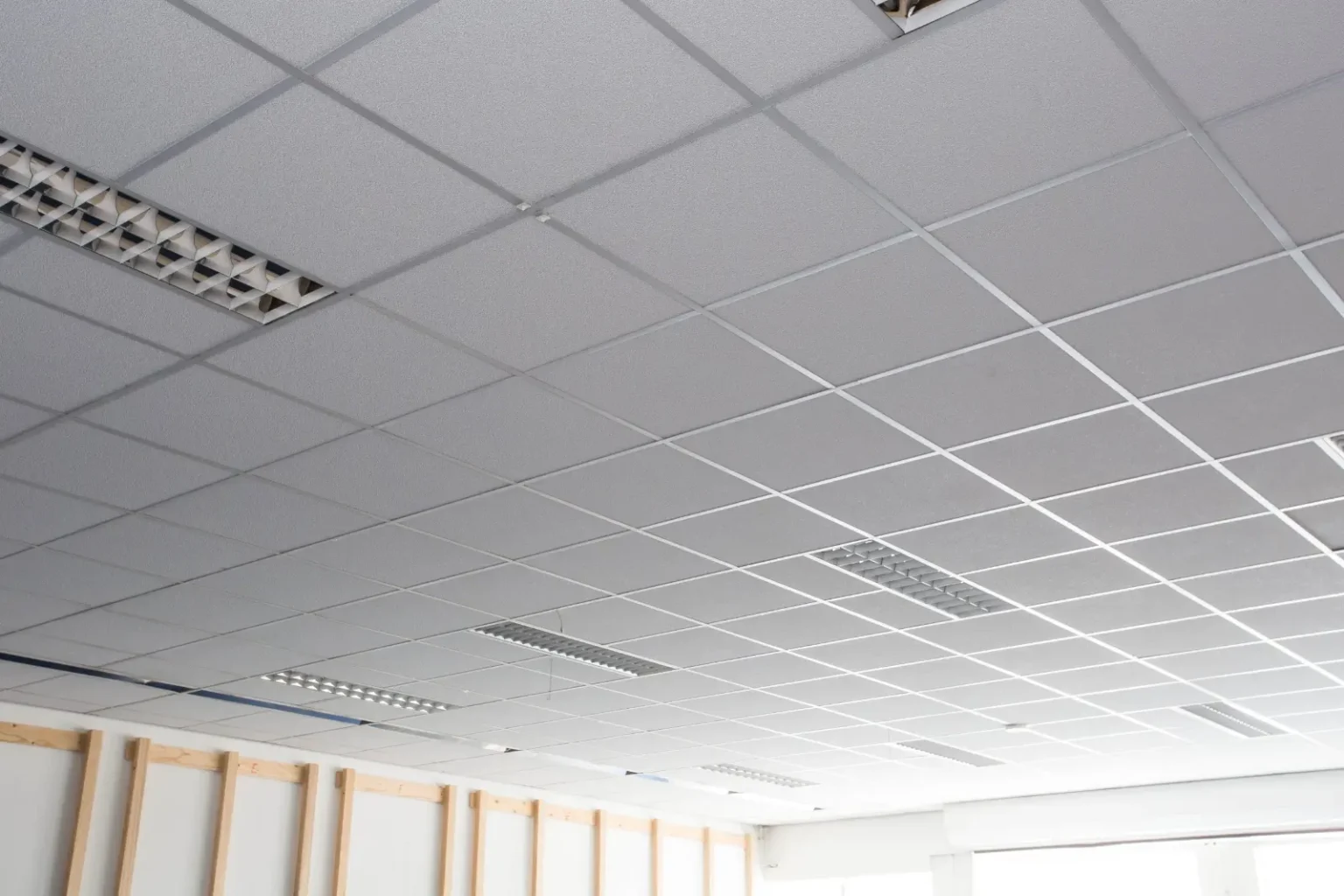
A grid ceiling — the exposed T-bar system everyone recognises — is still the right answer for most offices, because every tile lifts out. A suspended ceiling in 600×600 mineral fibre gives the landlord and the facilities team access to every cable, damper and valve without cutting anything, and a damaged tile is a two-minute swap rather than a patch, a skim and a repaint.
Where the brief wants a flatter, more finished look we mix the two: gypsum to the perimeter and the feature zones, grid over the open-plan core and the corridors where the services are densest. That keeps the reception and meeting rooms looking like a fit-out and the back-of-house looking like something you can maintain.
Acoustic ceiling work is the other half of a commercial job. An open-plan floor with porcelain, glass and gypsum has nothing to absorb speech, so it gets loud and stays loud. High-NRC mineral tiles, acoustic panels as rafts or clouds over the desks, and baffles where the ceiling has to stay exposed all measurably drop the reverberation. We specify to the room, not to a catalogue page.
We fit out offices, clinics, salons, showrooms and restaurants, and every one of them gets the same two non-negotiables: a ceiling for villa, apartment, office or shop is built with real access, and it is built to whatever fire rating the building handbook requires rather than the cheapest board on the shelf.
Ceiling repair and replacement
Most ceiling damage is a symptom. Patching it without finding the cause buys about eight months.
Ceiling water damage repair starts above the ceiling, not below it. A brown ring is almost always a chilled-water pipe sweating because its insulation has failed, an AC drain pan that no longer drains, or the bathroom of the flat upstairs. We open a section, trace it with a moisture meter, and tell you which of the three it is before we quote the making good — because if the source stays, the stain comes back through two coats of paint within a season.
A sagging ceiling is a fixing problem. Either the hangers were spaced too far apart, the board was fixed at the wrong centres, or a heavy fitting was hung off the board instead of off the frame. We lift a panel, look at the frame, and either re-hang the affected bay or replace it. A sagging ceiling that has been screwed back up flat without touching the frame will sag again.
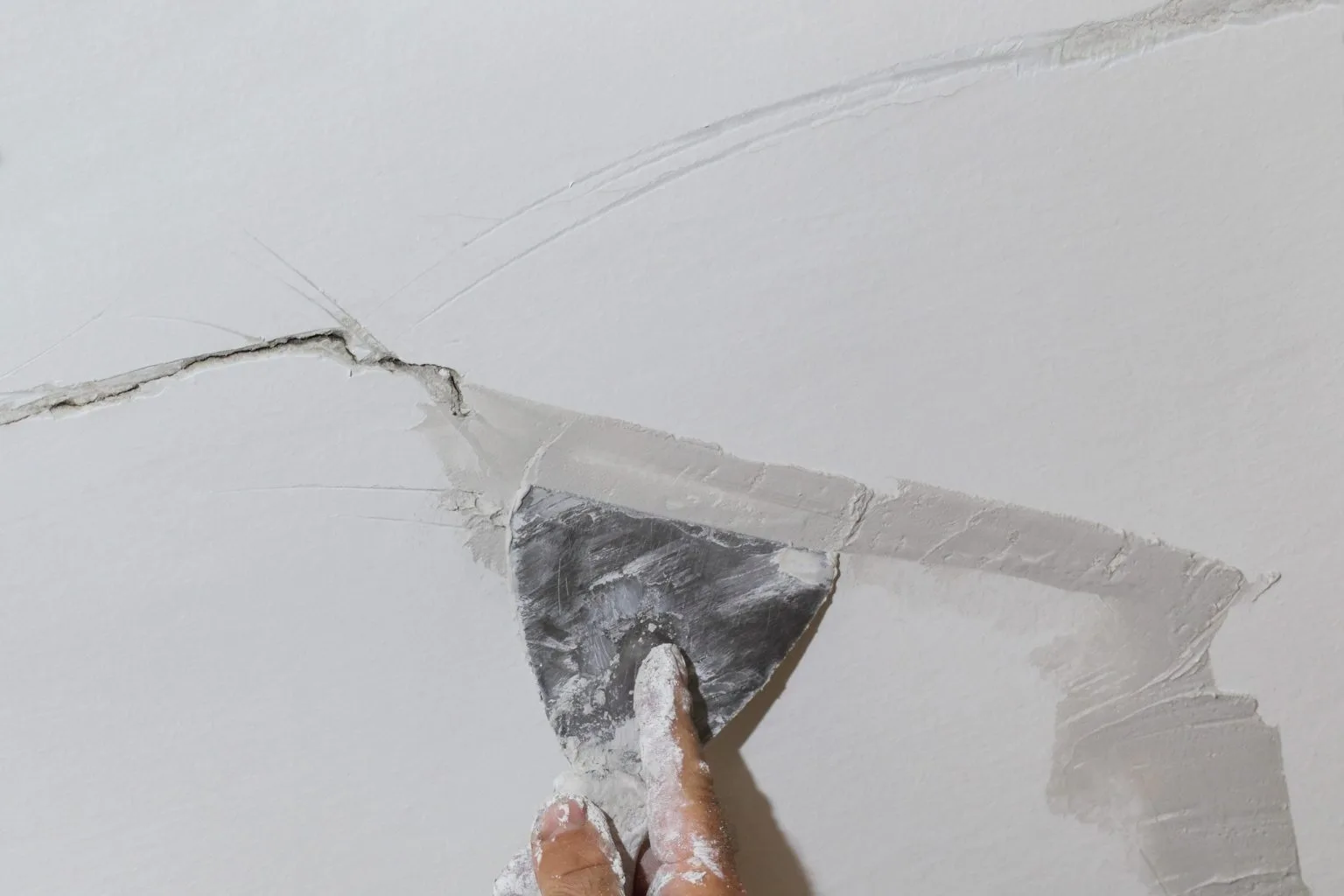
Crack repair is the most common call and the easiest to get wrong. A hairline along a board joint means the tape has failed and it needs cutting out, re-taping and re-skimming — filler alone reopens. A crack at the corner of an opening means the board joint was landed there and has to be cut back and re-boarded. Painting over either one is a cosmetic fix and we will say so.
Where the existing ceiling is beyond saving, removal and disposal is quoted separately at our published rate so you can see what the strip-out costs against the rebuild, rather than finding it folded into a square-foot price.
Wooden and slat ceilings
Timber is the one ceiling material people reach up and touch. It is also the one that moves, so it is built differently.
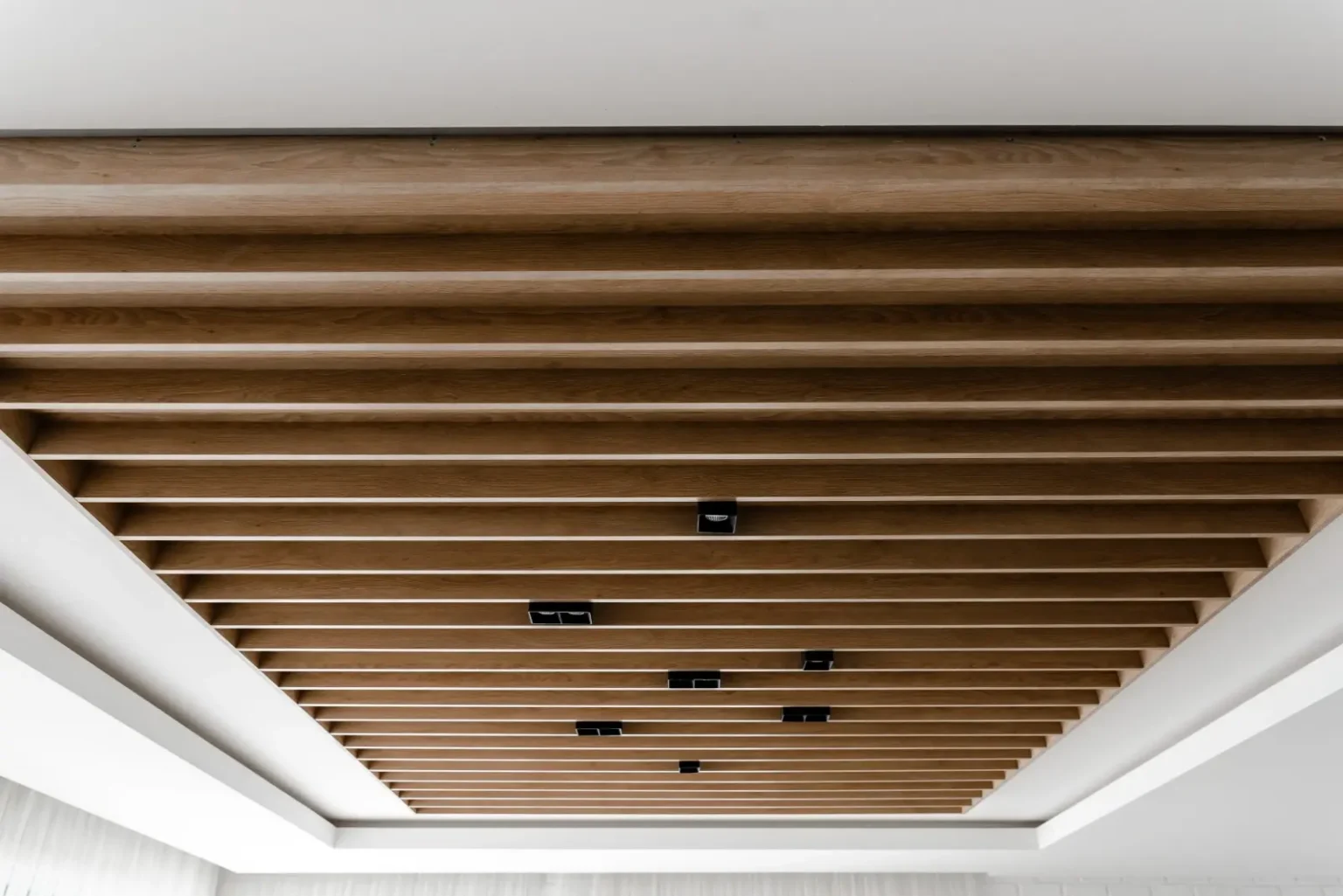
A wooden slat ceiling is our own joinery, made in the Ras Al Khor workshop and fixed to a gypsum or metal frame on site. The setting-out is the whole job: the slat module has to divide evenly into the run so you do not finish on a sliver, and it has to resolve against the downlights and the AC grille rather than being interrupted by them. We draw the elevation and get it approved before anything is machined.
Slats go up either as an open rhythm over a dark-painted backing — which reads deeper and hides the fixings — or on an acoustic felt backing, which does genuine sound absorption in a living room full of hard surfaces. Both are fixed to battens with a concealed clip or a shot from above, never face-screwed and filled.
A veneer ceiling is the flatter option: veneered MDF panels with a shadow-gap joint, sequenced across the run so the grain carries through. It needs a level frame more than any other finish, because a flat sheet under raking light shows every hollow. Timber also needs a gap to move, so we detail a shadow gap at every wall rather than scribing tight.
Ceiling painting and finishing
Every shortcut taken earlier in the job shows up here, under one raking light, on a flat white surface.
Ceiling skim coat is where a gypsum ceiling is actually made flat. Joints are taped and filled in three passes, feathered wide rather than built proud, then the whole ceiling is skimmed and sanded under a raking lamp so the ridges are visible while they can still be fixed. A ceiling that is only jointed and not skimmed looks fine by daylight and shows every band the moment a cove light washes across it.
Ceiling painting is one mist coat and two full coats in a proper matt emulsion, rolled in one direction and laid off in the other. Matt, always — any sheen on a ceiling turns every small undulation into a visible wave. We paint after the lighting cut-outs are made, not before, so there is no touch-up ring round every downlight.
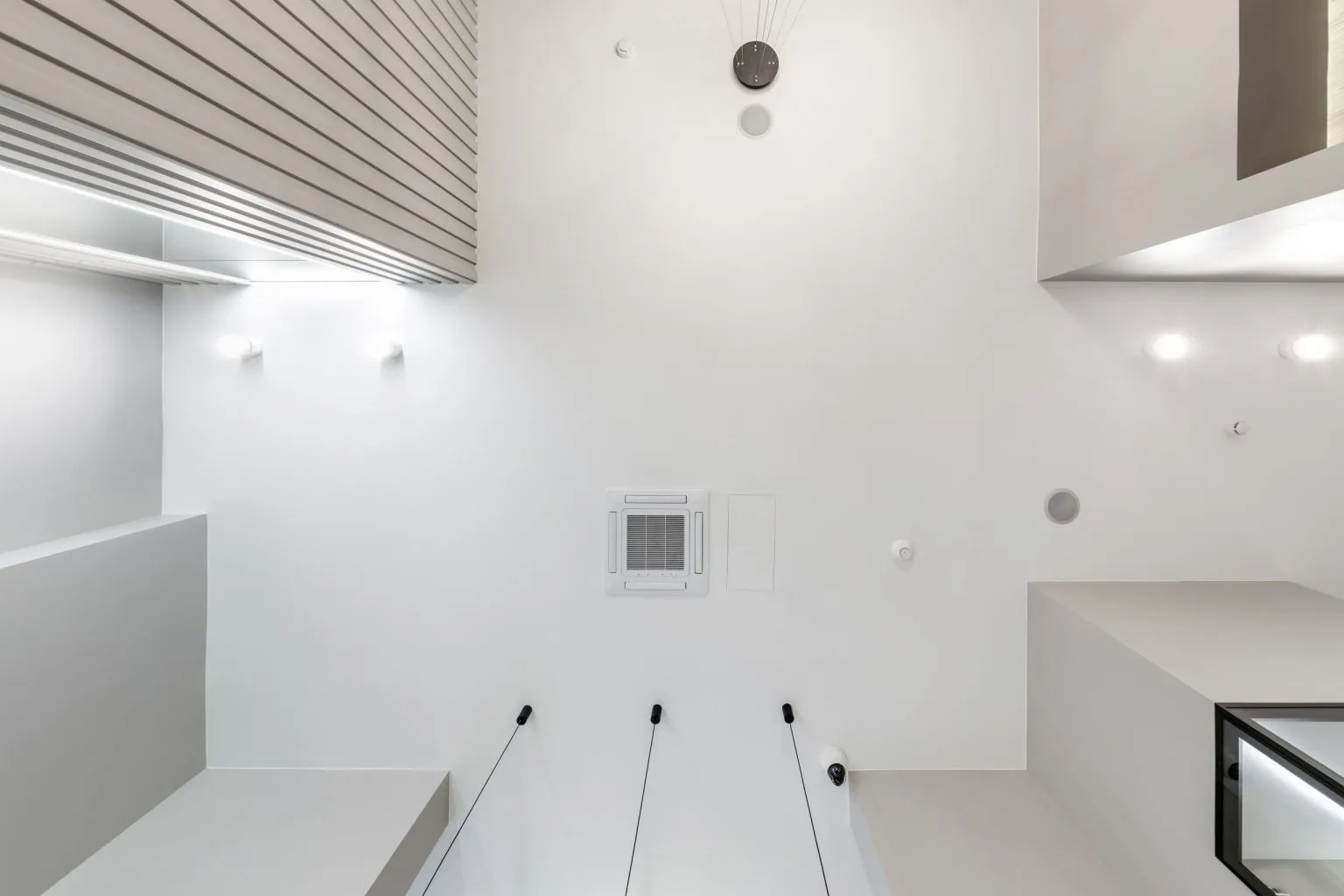
Ceiling access panels are the detail clients forget and facilities teams curse. Every valve, damper, driver, water heater and junction box gets a flush, finished panel sized to the thing behind it, painted in with the ceiling so it almost disappears. We list them on the drawing at design stage, because adding one afterwards means cutting a finished ceiling.
AC grilles and diffusers are set out on the same plan as the lights, squared to the room and to each other, with the duct actually sized to reach them. And where a ceiling sits under a roof slab or a hot void, ceiling insulation goes in above the board while it is open — it is a small cost during the works and a serious one afterwards.
False ceiling cost in Dubai
Our own published rates. Ceilings are priced by area and by the running metre of detail, because the detail is where the labour actually goes.
| Type | Typical range | Notes |
|---|---|---|
| Flat gypsum ceiling | AED 45 – 60 / sq ft | Framing, board, tape, skim and two coats of paint |
| Ceiling with bulkhead or perimeter drop | AED 55 – 75 / sq ft | Conceals ducting, beams or curtain tracks |
| Tray or coffered ceiling | AED 70 – 90 / sq ft | Multi-level, needs adequate void depth |
| Cove or shadow-gap detail | AED 120 – 220 / linear m | Formed to take LED profile lighting |
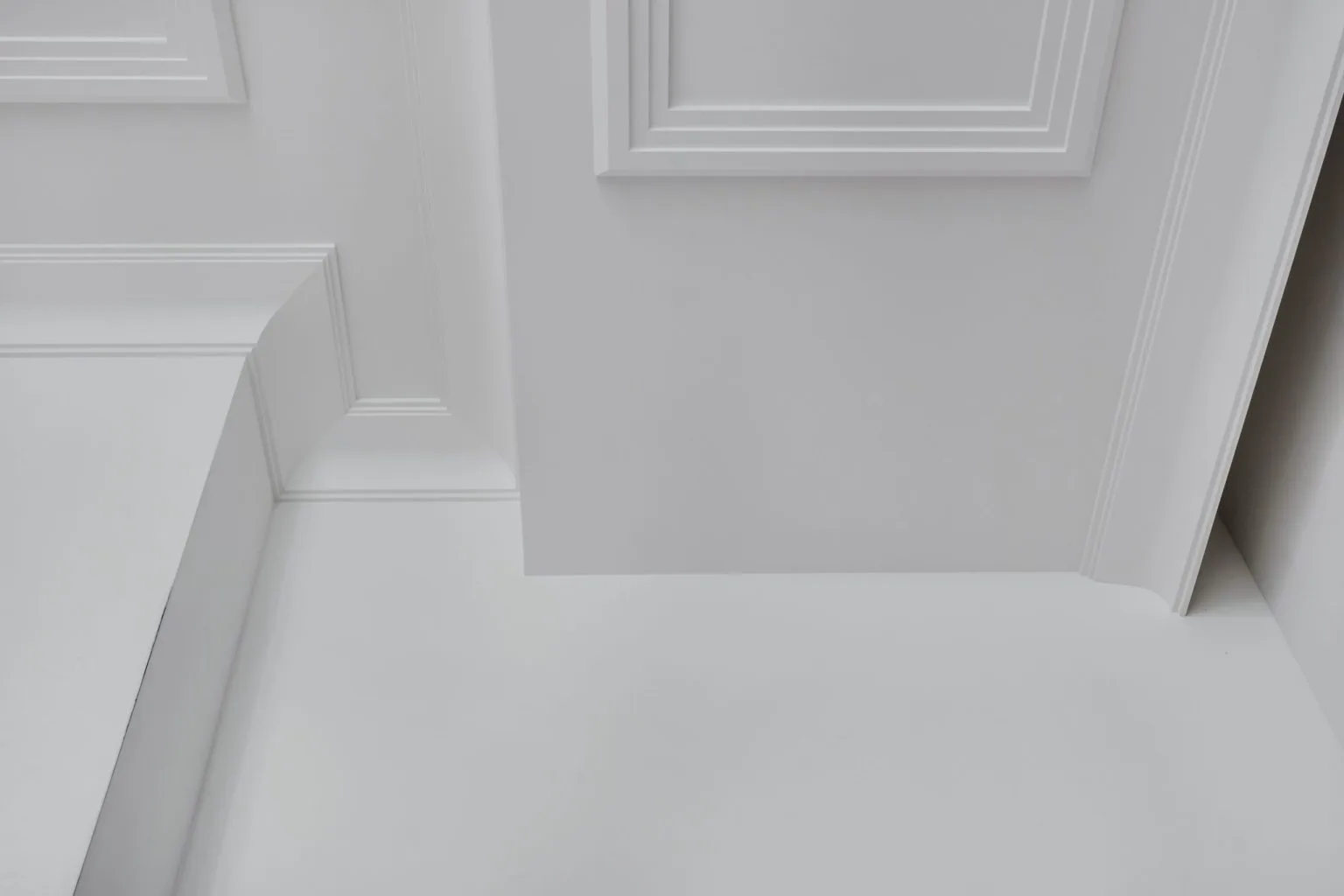
| Plaster cornice and mouldings | AED 90 – 260 / linear m | Supply and install, matched to existing where required |
| Access panel, flush and finished | AED 350 – 900 each | Sized to the equipment behind it |
| Acoustic ceiling treatment | AED 90 – 180 / sq ft | Cinema, studio and meeting room applications |
| Ceiling removal and disposal | AED 12 – 22 / sq ft | Where an existing ceiling is being replaced |
False ceiling cost per sq ft Dubai starts at AED 45 to 60 for a flat gypsum ceiling, supplied and installed — and that figure includes the framing, the board, the taping, the skim and two coats of paint, not just the boarding. A perimeter drop or bulkhead takes it to AED 55 to 75, and a tray or coffered ceiling to AED 70 to 90, because each extra level means another set of framing, another set of external corners and another run of taping.
Coves, cornices and access panels are quoted separately on their own units for a reason: two rooms of the same area can differ by thousands of dirhams depending on how many linear metres of cove they carry. Pricing them inside a square-foot rate hides that, and it is how a quote that looked cheap turns into a variation.
False ceiling installation of a single room typically takes four to seven working days including curing and painting; a full apartment runs two to three weeks alongside the other trades. What is not in the rate: relocating ducting or sprinklers, structural work, and any lighting fittings themselves — we install them, but the fittings are your supply or a separate line.
False ceiling and gypsum works in Dubai
How much does a false ceiling cost per sq ft in Dubai?
False ceiling cost per sq ft Dubai starts at AED 45 to 60 for a flat gypsum ceiling, supplied and installed — framing, board, taping, skim and two coats of paint included. A bulkhead or perimeter drop is AED 55 to 75, and a tray or coffered ceiling AED 70 to 90. Coves are priced separately at AED 120 to 220 per linear metre, cornices AED 90 to 260, and access panels AED 350 to 900 each, because those are where the labour actually goes. Where an existing ceiling has to come down, removal and disposal is AED 12 to 22 per sq ft, quoted as its own line.
How long does false ceiling installation take?
Four to seven working days for a single room, and two to three weeks for a full apartment alongside the other trades. The sequence cannot be compressed much: the frame has to be levelled before boarding, the taping needs three passes with drying time between them, and the skim has to be fully dry before paint. Anyone promising a finished, painted ceiling in two days is skipping the skim, and you will see it the first evening the cove light comes on.
What is the difference between gypsum and grid ceilings?
A gypsum ceiling is board screwed to a metal frame, then taped, skimmed and painted into one continuous flat surface — it looks seamless, takes any shape, and hides services completely, but getting above it means cutting it. A grid ceiling is a visible T-bar frame with 600×600 tiles dropped in, so every tile lifts out for access and a damaged one is swapped in a minute. Gypsum for homes and front-of-house; grid where services need reaching. Most commercial jobs use both.
Can a false ceiling be installed in a rented apartment in Dubai?
Usually yes, but not without permission. Almost every building requires an NOC from the owners’ association or building management before ceiling work starts, and the landlord’s written consent as well, since you are altering the unit. Where sprinklers, smoke detectors or fire-rated construction are affected, a permit through the relevant authority is also needed. We prepare the drawings and handle the submission as part of the job — and we would rather tell you at survey that a building will refuse it than start and be stopped.
Will I lose much ceiling height?
A flat gypsum ceiling needs about 75 to 100 mm of drop for the frame alone. Where ducting or a beam has to be concealed, a bulkhead can take 250 to 400 mm in that zone. We measure the slab and the services at survey and tell you the exact finished height before you commit — in a low apartment that number sometimes changes the design, and it is better to know on day one.
Do you handle the lighting and the electrical work?
Yes, both. Our own electricians run the circuits at first fix, we cut the openings to the approved plan, and we set, connect and test the fittings at the end. Drivers and transformers are left accessible behind a panel rather than buried. If you are supplying your own fittings, send us the cut-out sizes before boarding so the holes are right the first time.
Will the ceiling crack?
Not if the frame is right. Cracking comes from hangers spaced too far apart, joints landed at the corner of an opening, or taping done in one thick pass instead of three thin ones. We fix at proper centres, stagger the joints, tape in three passes and skim the whole surface. If a crack does appear in a ceiling we built, we come back and cut it out properly rather than filling it.
Can you match an existing cornice or ceiling detail?
In most cases, yes. We take a profile of the existing cornice, have the run made to match, and blend it into the new work. Where an exact match is not possible — an old imported profile, a discontinued mould — we say so and show you the closest option rather than promising and disappointing at installation.
Do you do acoustic ceilings for a cinema or a studio?
Yes. Acoustic treatment is priced separately at AED 90 to 180 per sq ft, because it is a different build: absorbent backing, resilient fixings and either a perforated or slatted face, sized to the room rather than picked from a catalogue. A home cinema, a podcast room and an open-plan office all need different treatments, and we would rather measure the room than guess.
Do you work with fit-out contractors as well as homeowners?
Both. For contractors we work to the BOQ and the reflected ceiling plan, coordinate with the MEP programme, and sequence to your site access. For homeowners we survey, draw, build and finish directly. Either way the ceiling plan is approved before framing starts.
Which areas of Dubai do you cover?
All of it — Dubai Marina, Downtown, JVC, Dubai Hills, Damac Hills, Arabian Ranches, Mirdif and Business Bay among them. Our workshop and stores are in Ras Al Khor Industrial Area 2, which is central to all of those, so a missing access panel or a re-cut grille is a same-day fix rather than a lost week.
How do I get a quotation?
Call or WhatsApp 056-5608073, or email contact@abdullacarpentryest.ae with the room sizes and a few photographs looking up. We arrange a free site visit and ceiling quotation, usually within a couple of days. The survey checks the slab height, the existing services and the lighting you want, and the written quotation follows itemised by area and by linear metre of detail.
Useful official references
Ceiling work sits under building permits, fire and life safety rules and your building’s own handbook. These are the primary sources we work to, and they are worth reading before you approve any ceiling drawing.
Book a free ceiling survey
A free site visit and ceiling quotation, anywhere in Dubai. We measure the slab, check what is already in the void, mark up the lighting with you, and send a written quotation itemised by area and by linear metre of detail. Call or WhatsApp 056-5608073, or email contact@abdullacarpentryest.ae.