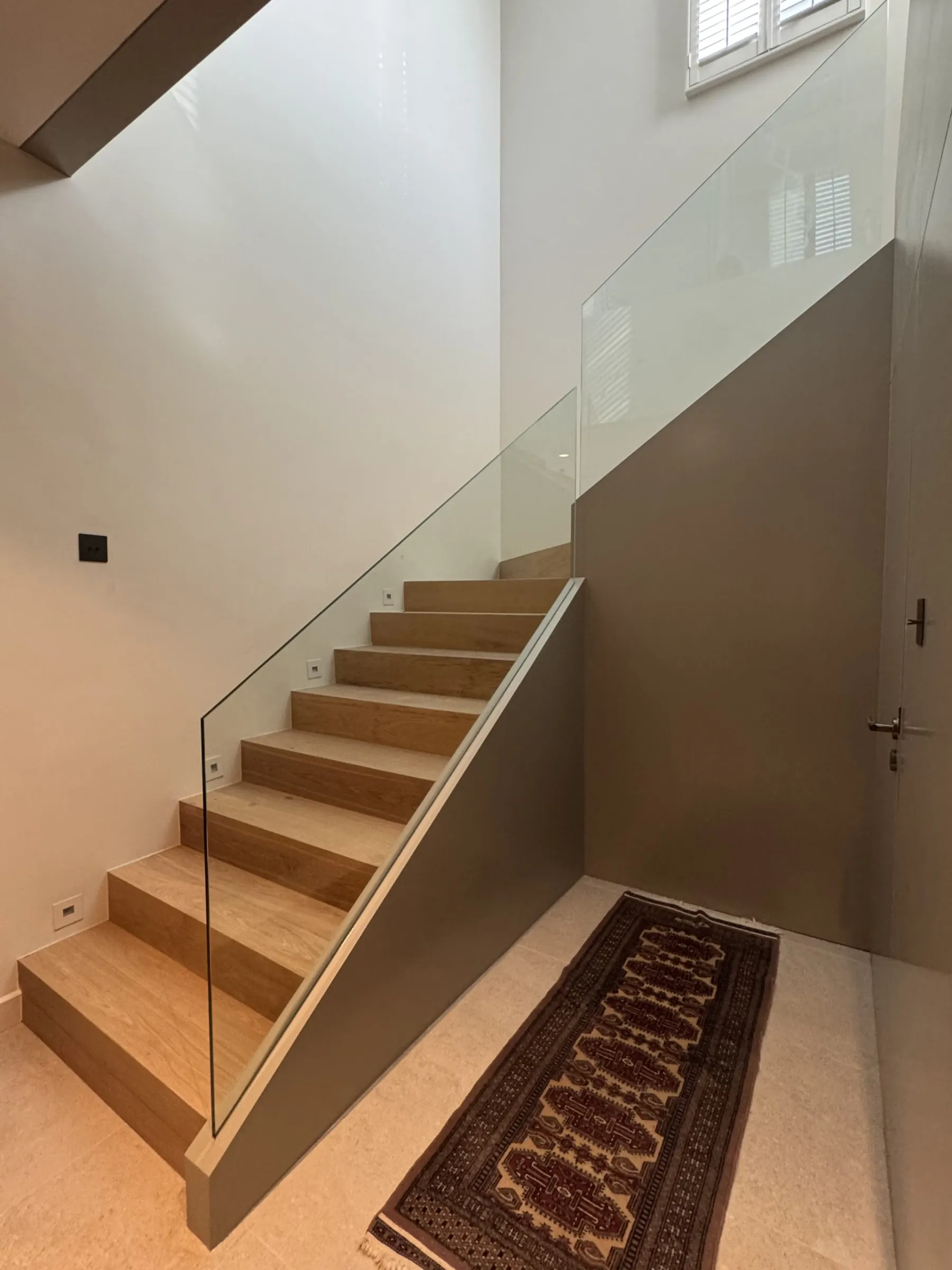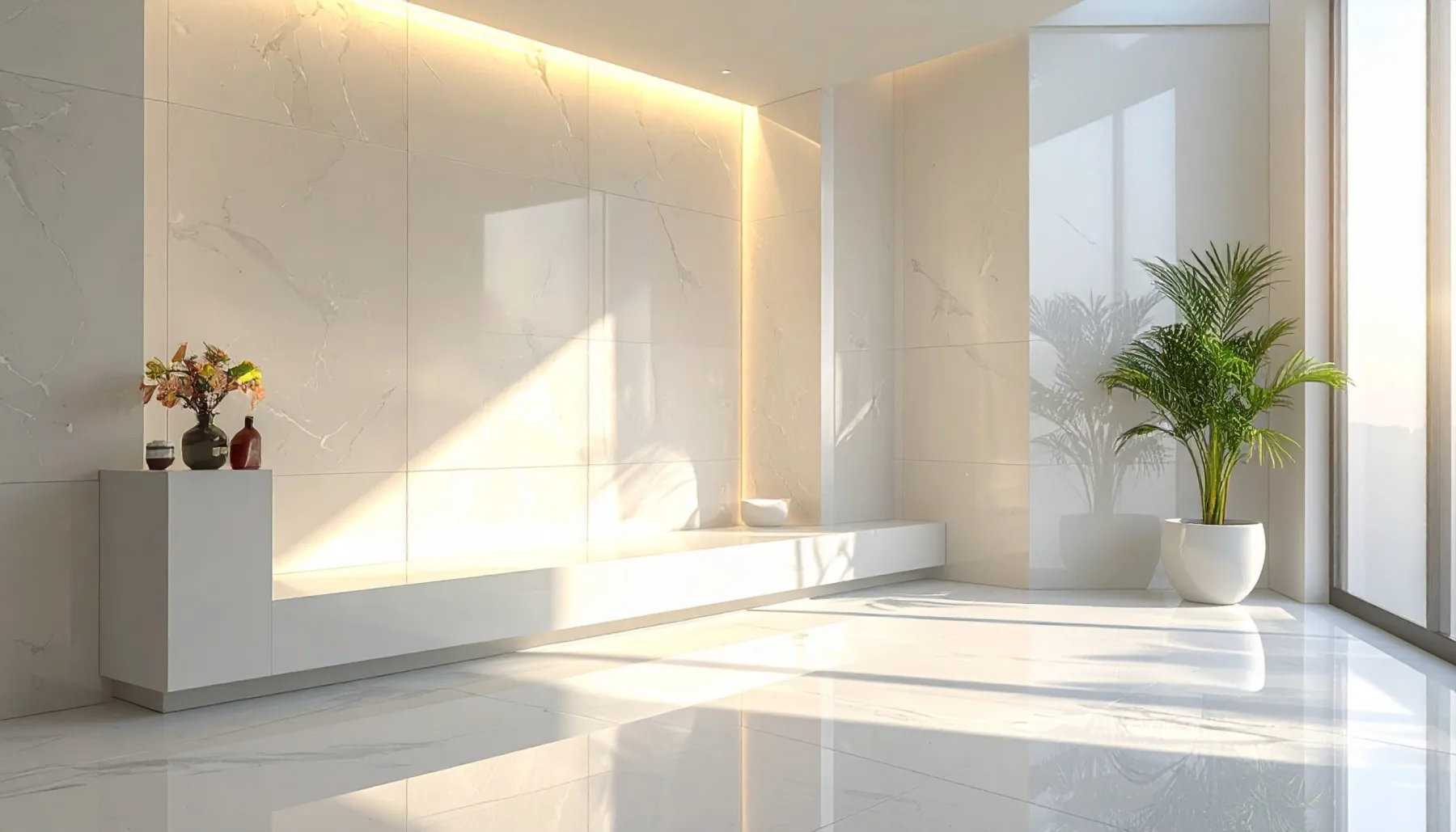
Stone works in Dubai, cut to the slab in front of you
Marble, granite, quartz, porcelain and onyx — worktops, vanities, wall cladding, flooring and staircases, templated on site, cut to your selected slab and installed with the veining running where you want it.
What stone works covers and what it costs
Stone works in Dubai covers supplying, fabricating and installing natural and engineered stone: kitchen worktops, bathroom vanities, wall and feature cladding, flooring, staircase treads and window sills. Expect AED 280 to 650 per square metre for engineered quartz, AED 350 to 1,400 for marble and granite, and considerably more for book-matched or exotic slabs. Abdulla Carpentry EST templates digitally on site and lays out the cuts on the actual slab so you see where the veining falls before anything is cut.
There is one thing about stone that catches people out, and it is worth saying plainly: no two slabs are the same. The marble in the showroom sample is not the marble that arrives on your site unless someone reserved that specific slab. Veining, background tone and movement vary from block to block and even from slab to slab within a block.
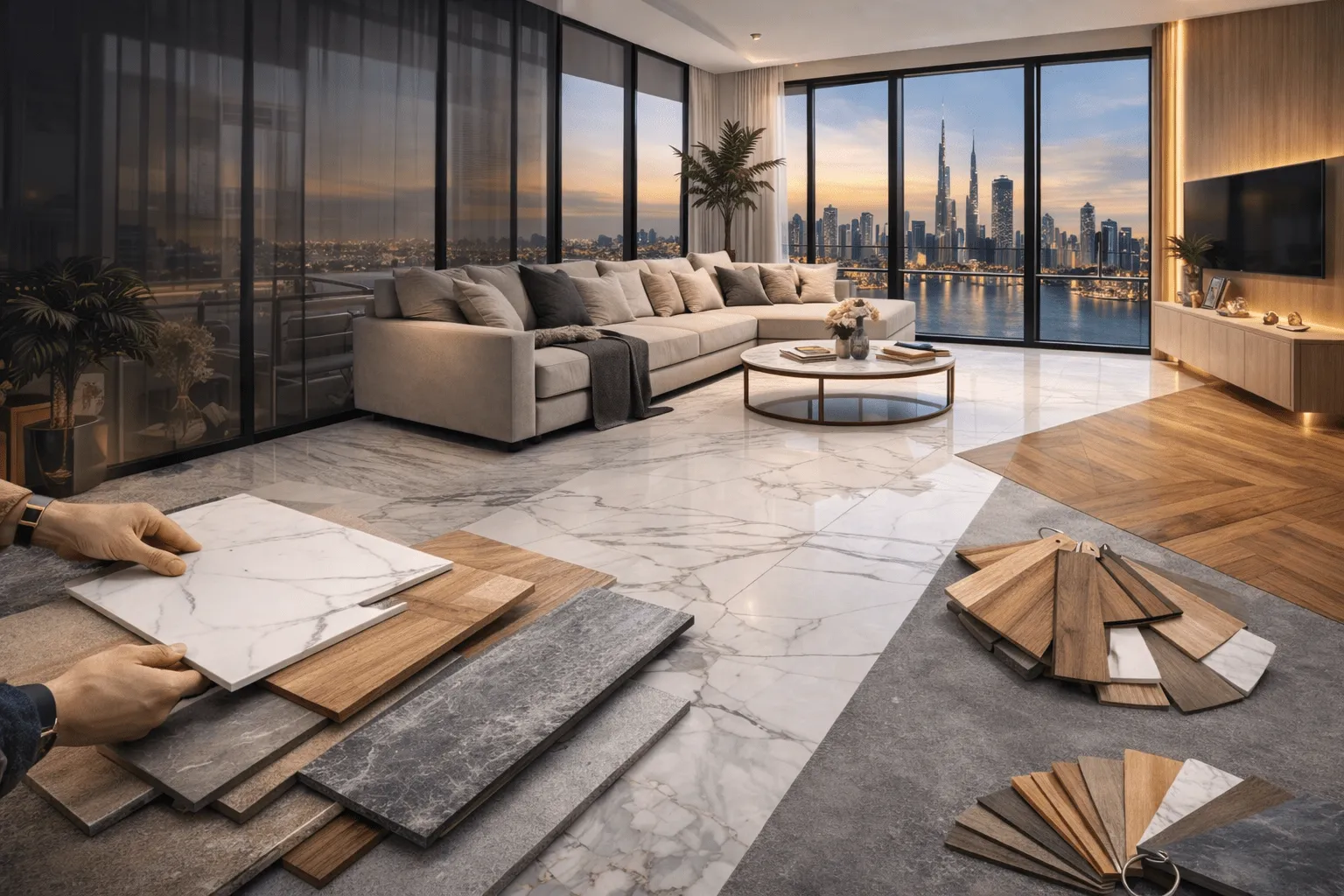
So the process runs in a particular order. You choose the material, then you go to the yard and select the actual slabs, and they are tagged and held in your name. Then we template, then we lay the cuts out on those slabs — digitally, so you can see exactly where the vein will run across the island and up the splashback — and only then does the saw start.
Skip that and you get a worktop where the veining stops dead at the joint, or a book-matched wall where the halves do not meet. Stone is unforgiving because it cannot be re-cut. Getting the layout right before cutting is most of the craft.
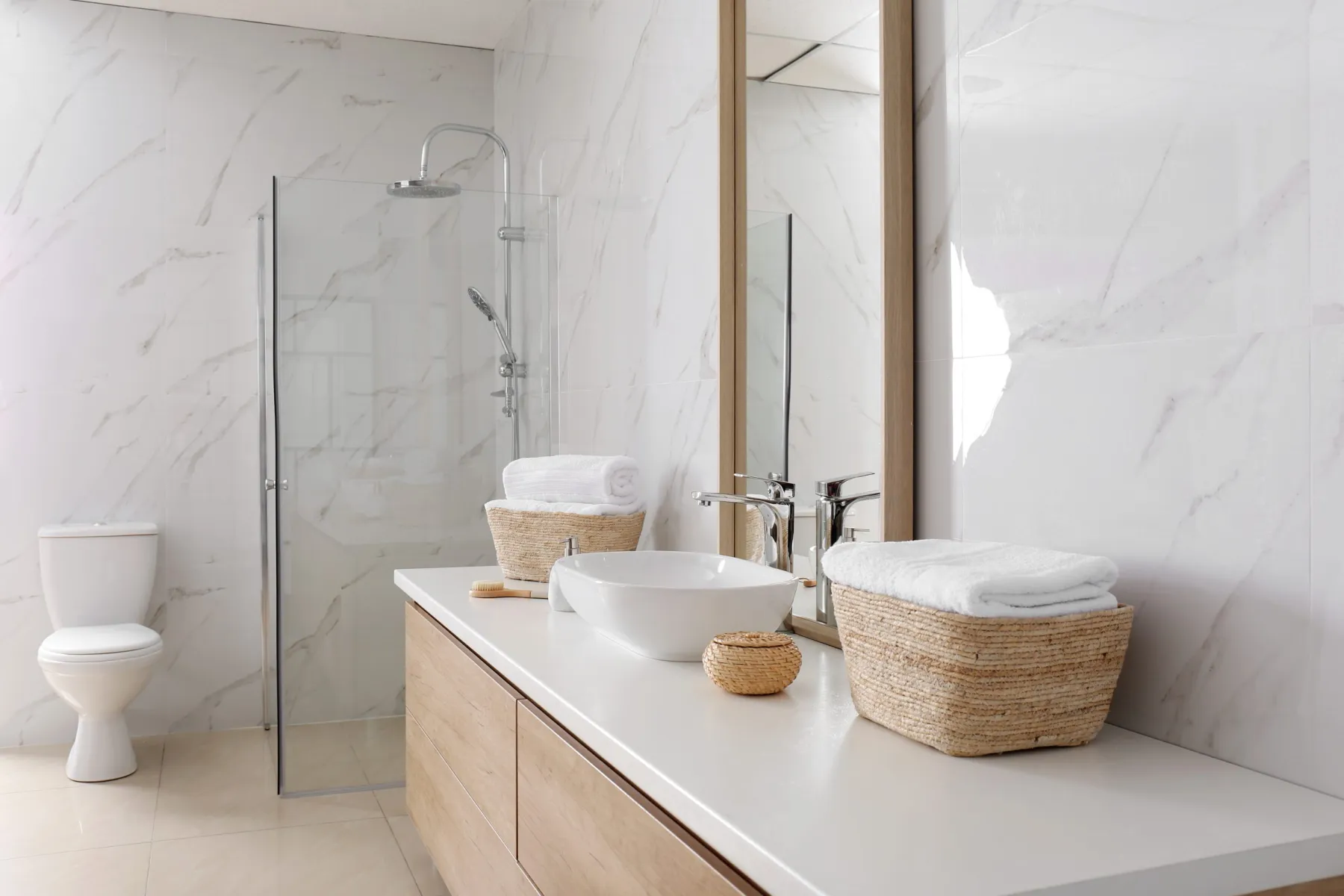 Slab selectedLayout before cutting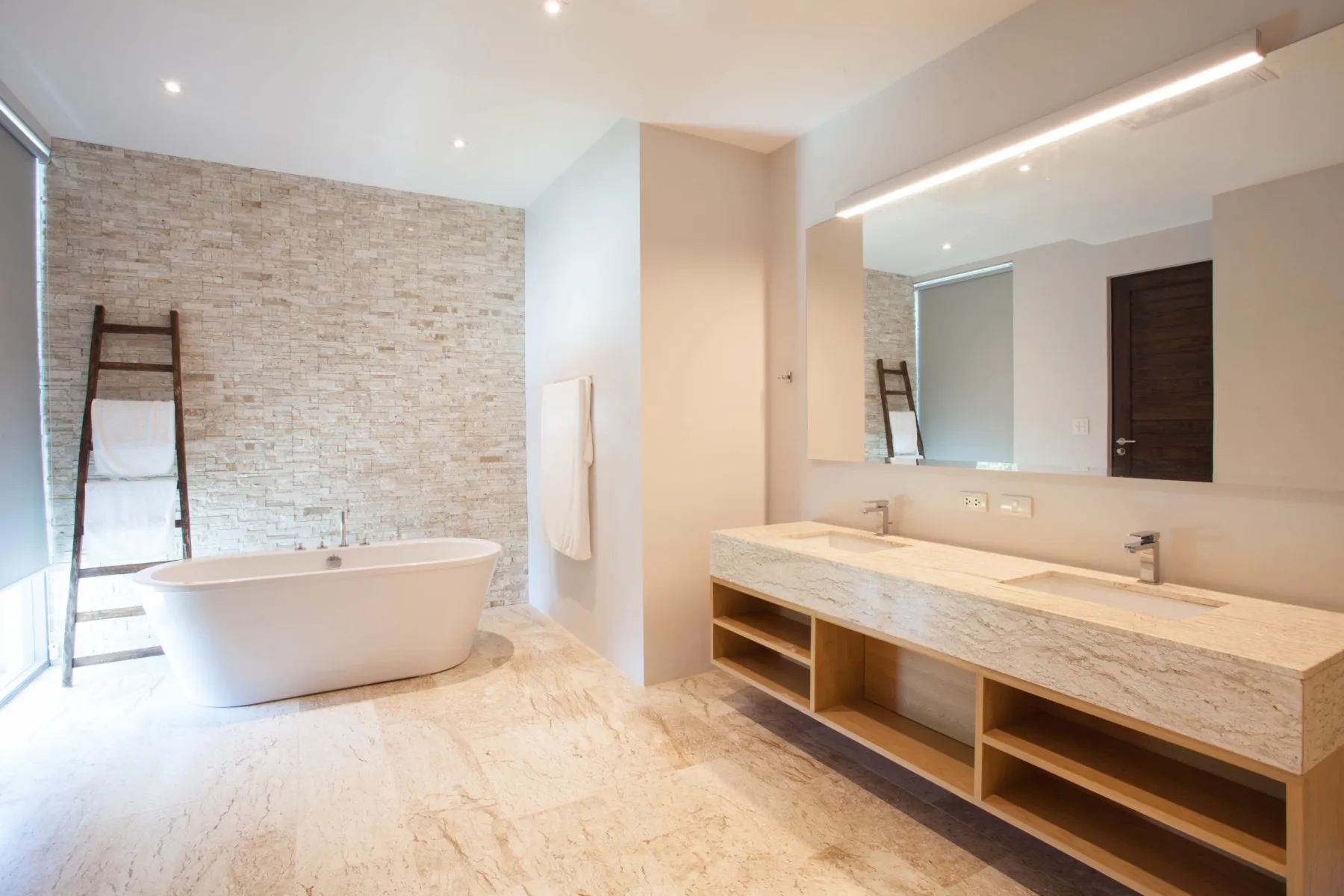
Marble, granite, quartz, porcelain — and where each belongs
Material choice here is mostly about how the surface will be used, not how it looks. Every one of these can be made to look beautiful; they do not all behave the same way in a working kitchen.
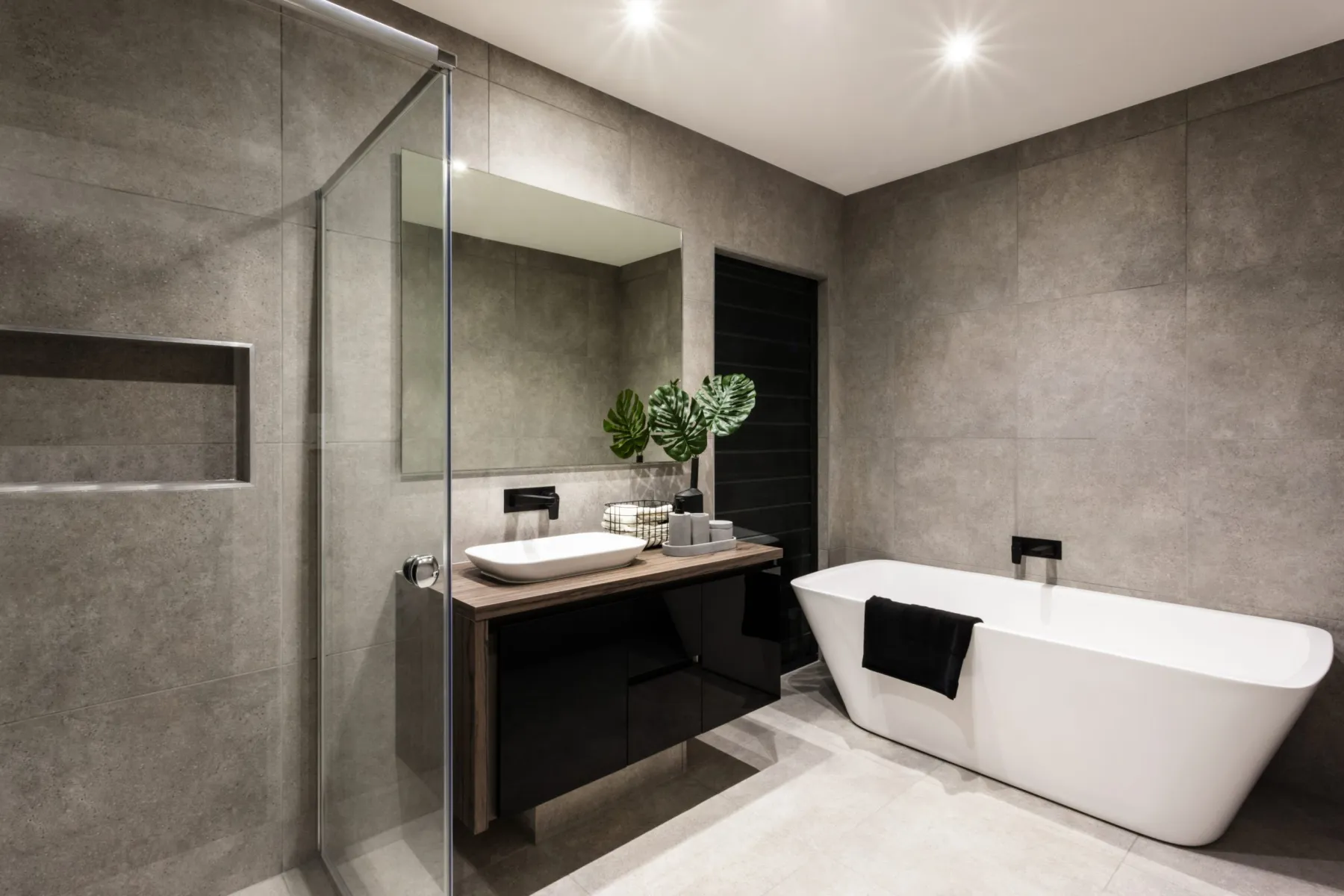
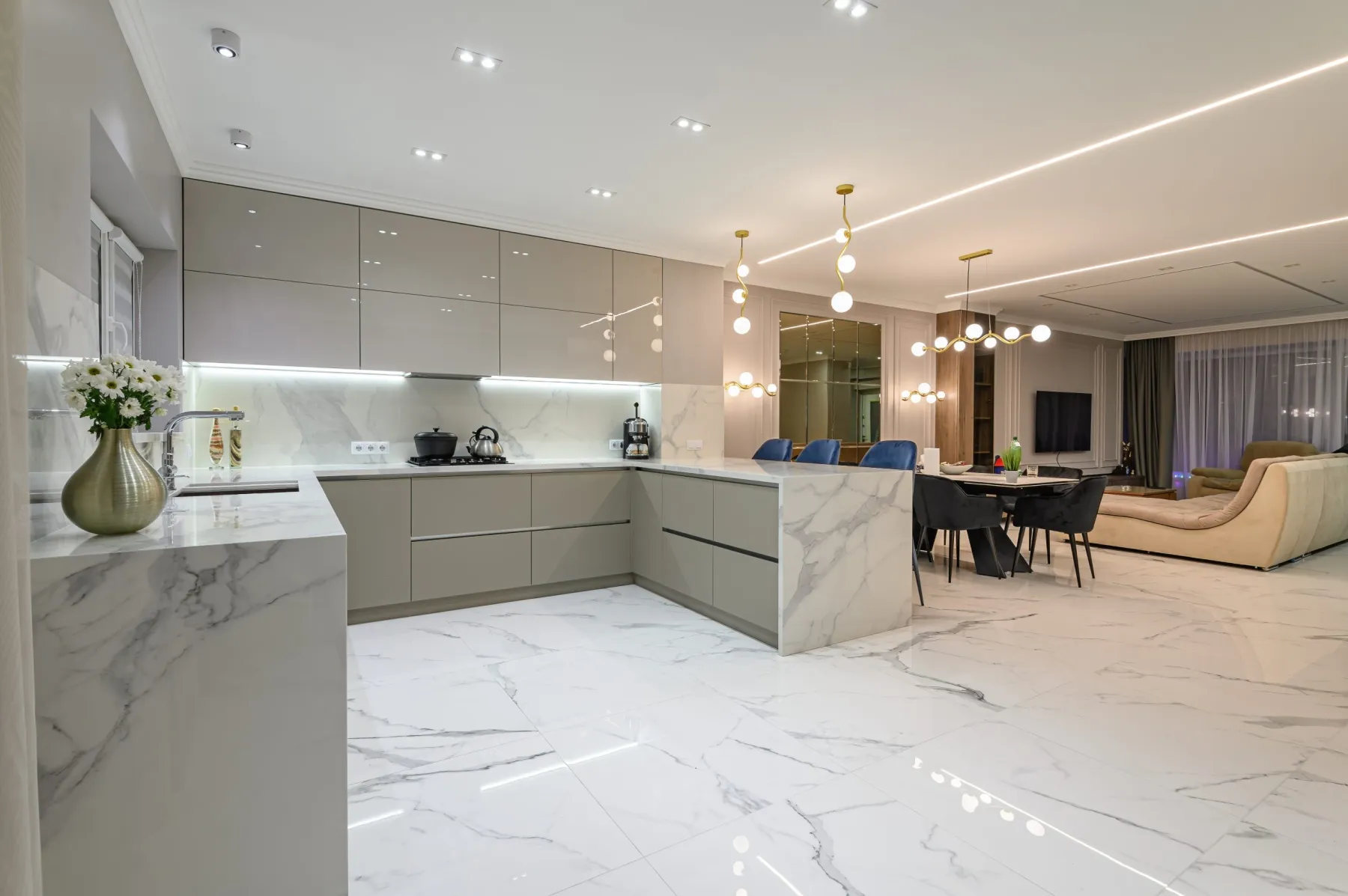
Marble. Unmatched depth and veining, and the reason most people start looking at stone at all. It is also porous and acid-sensitive: lemon juice, wine and descaler will etch the polished surface. Superb on a vanity, a feature wall or a fireplace. On a busy kitchen island it will patina, and you have to want that.
Granite. Harder, denser, far more stain and heat resistant than marble, and the traditional workhorse worktop. Modern granites in quieter greys and blacks read very differently from the speckled 1990s stone people remember.
Engineered quartz. Ninety per cent ground quartz in a resin binder. Non-porous, consistent slab to slab, no sealing, excellent stain resistance. The sensible choice for a kitchen that gets used hard. It does not like direct heat, so trivets still matter.
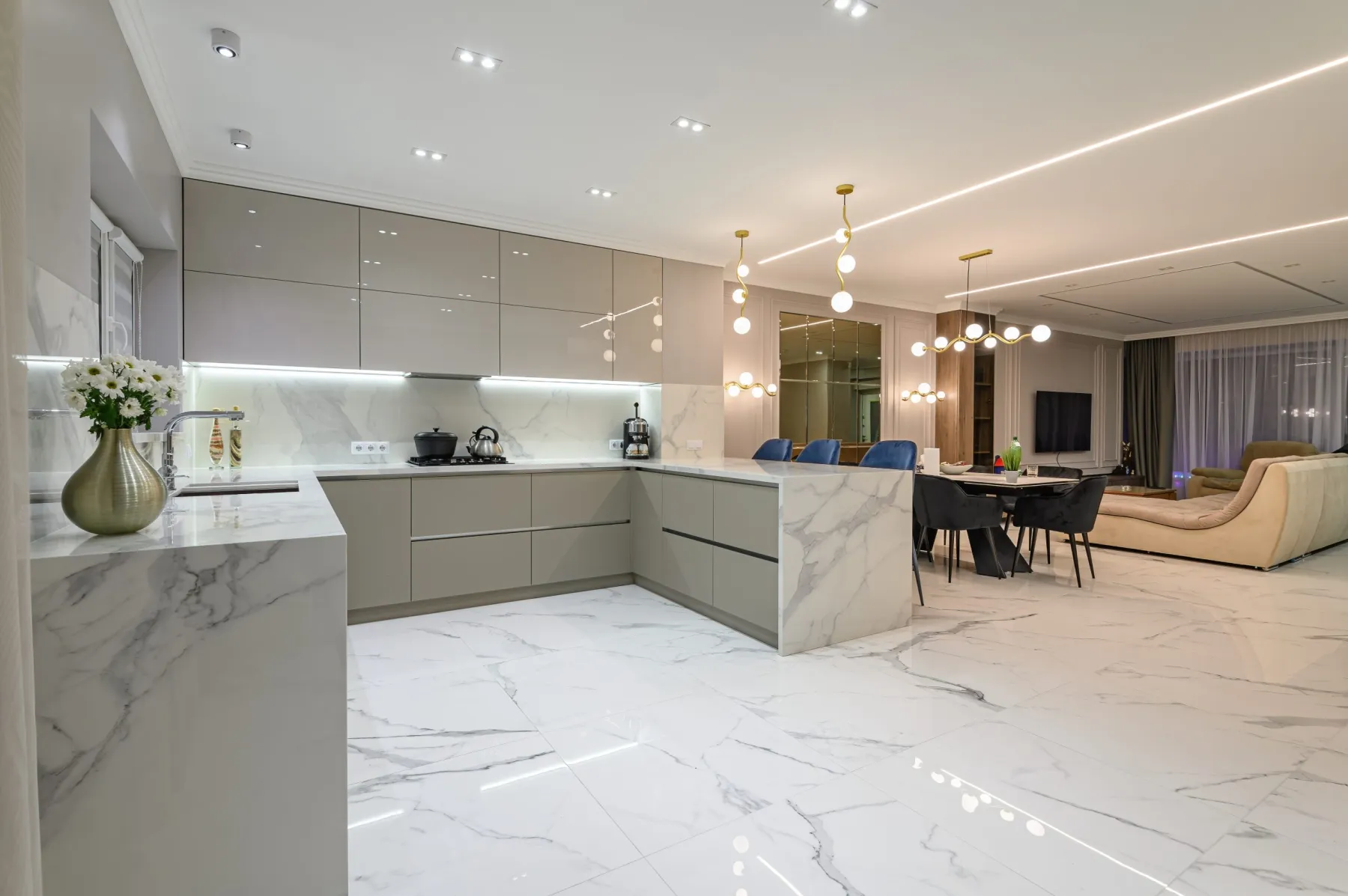
Porcelain and sintered stone. Large-format ultra-compact slabs, six to twelve millimetres thick. Heat proof, UV stable, nearly unscratchable, and available in convincing marble patterns. The right answer for outdoor kitchens and anywhere sunlight is relentless.
Onyx and exotic stone. Translucent, often backlit, used as a feature rather than a surface. Expensive, fragile and spectacular. Usually resin-backed and installed on a metal sub-frame.
Terrazzo and agglomerate. Aggregate set in cement or resin, cast into slabs. Back in demand for floors, vanities and stair treads, and available in colours natural stone cannot offer.
Edges, joints and the things that show
Edge profile changes the character of a worktop more than most people expect. A square eased edge reads modern and shows the slab thickness honestly. A mitred edge builds the apparent thickness up to 40, 60 or 100 millimetres by folding a return underneath — dramatic on an island, and the mitre joint has to be perfect because it sits at eye level. Bullnose, bevel and ogee profiles belong to a more traditional kitchen.
Joints are the other tell. A long run needs a joint somewhere; the skill is putting it where it is least visible and colour-matching the resin so it disappears. We place joints away from sinks and hobs, never across a corner, and we dry-fit before final fixing.
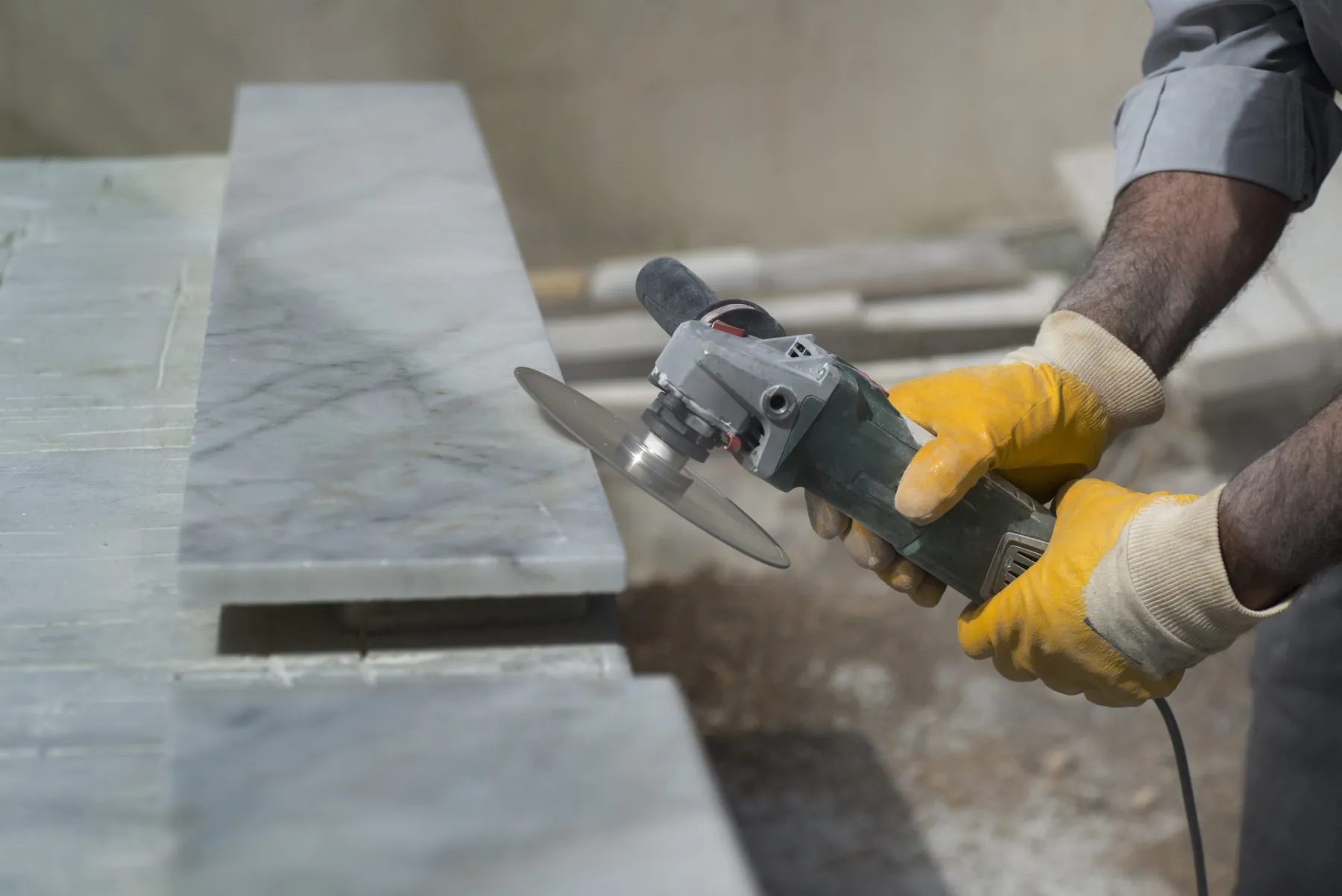
Then the cut-outs. Undermount sinks, flush-fit hobs, drainer grooves, tap holes and pop-up socket cut-outs are all machined in the workshop from templated dimensions, not cut on site with an angle grinder. Anything cut on site in dust and haste is a chip waiting to happen.
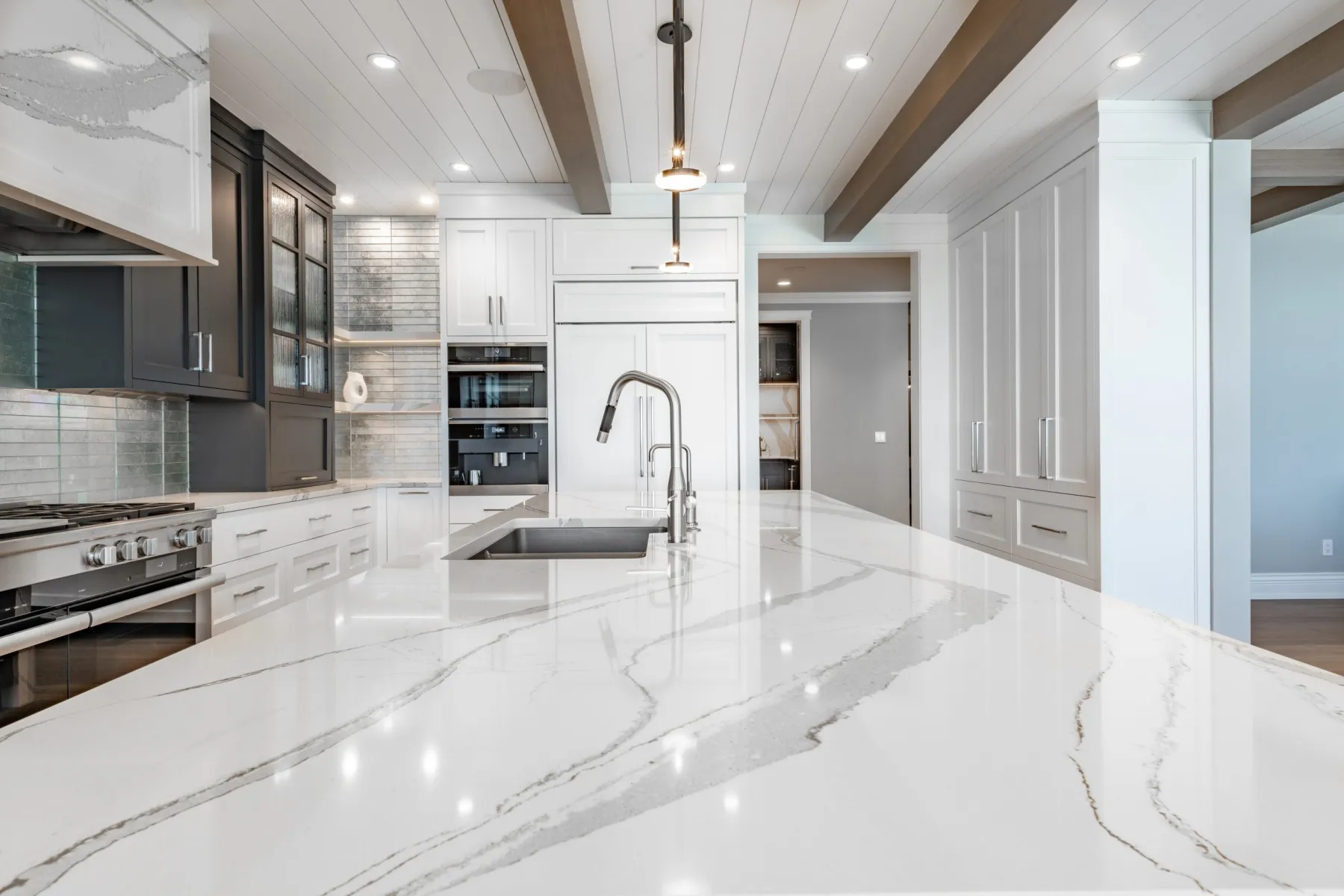 Mitred edgesMachined, not site-cut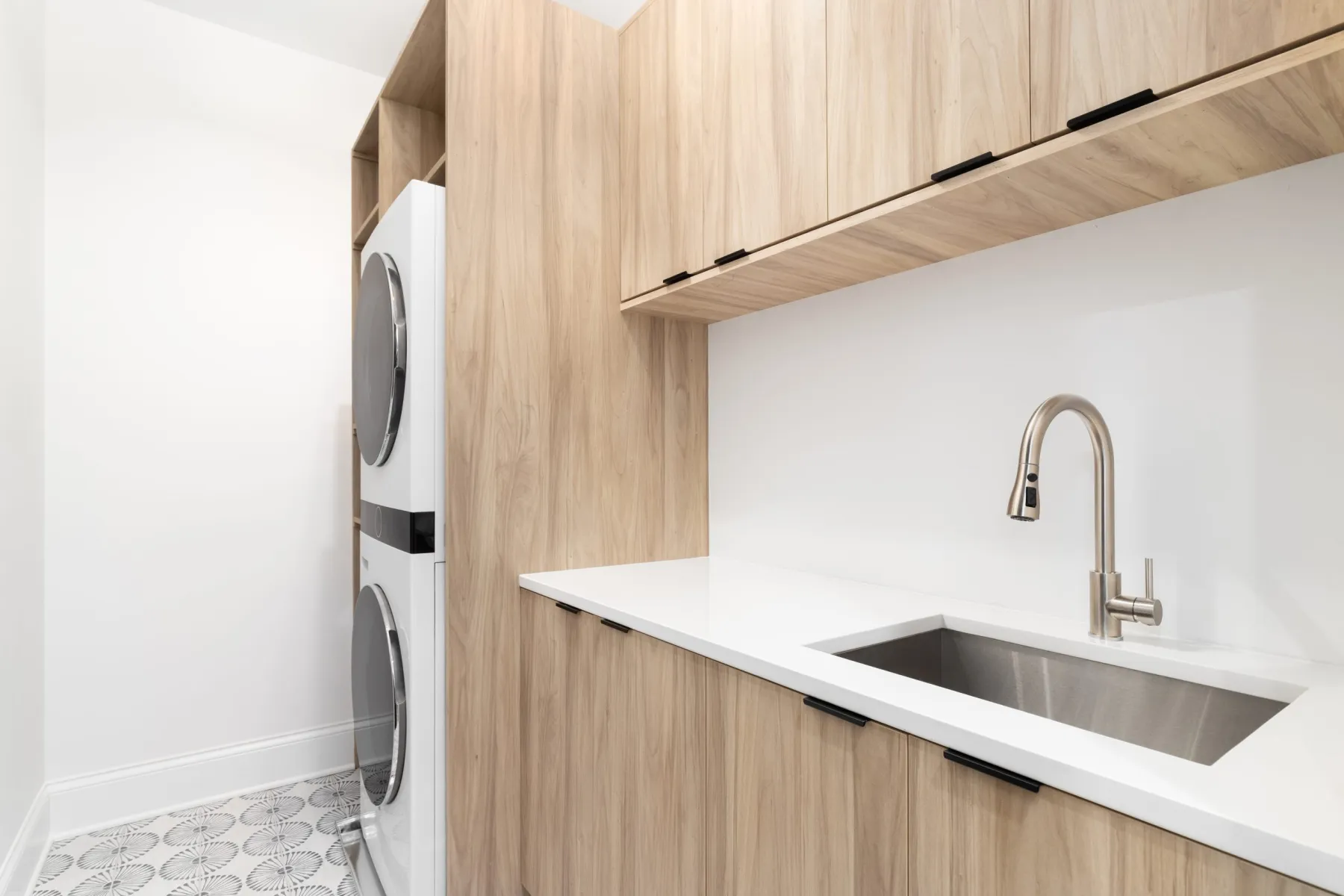
How a stone job runs
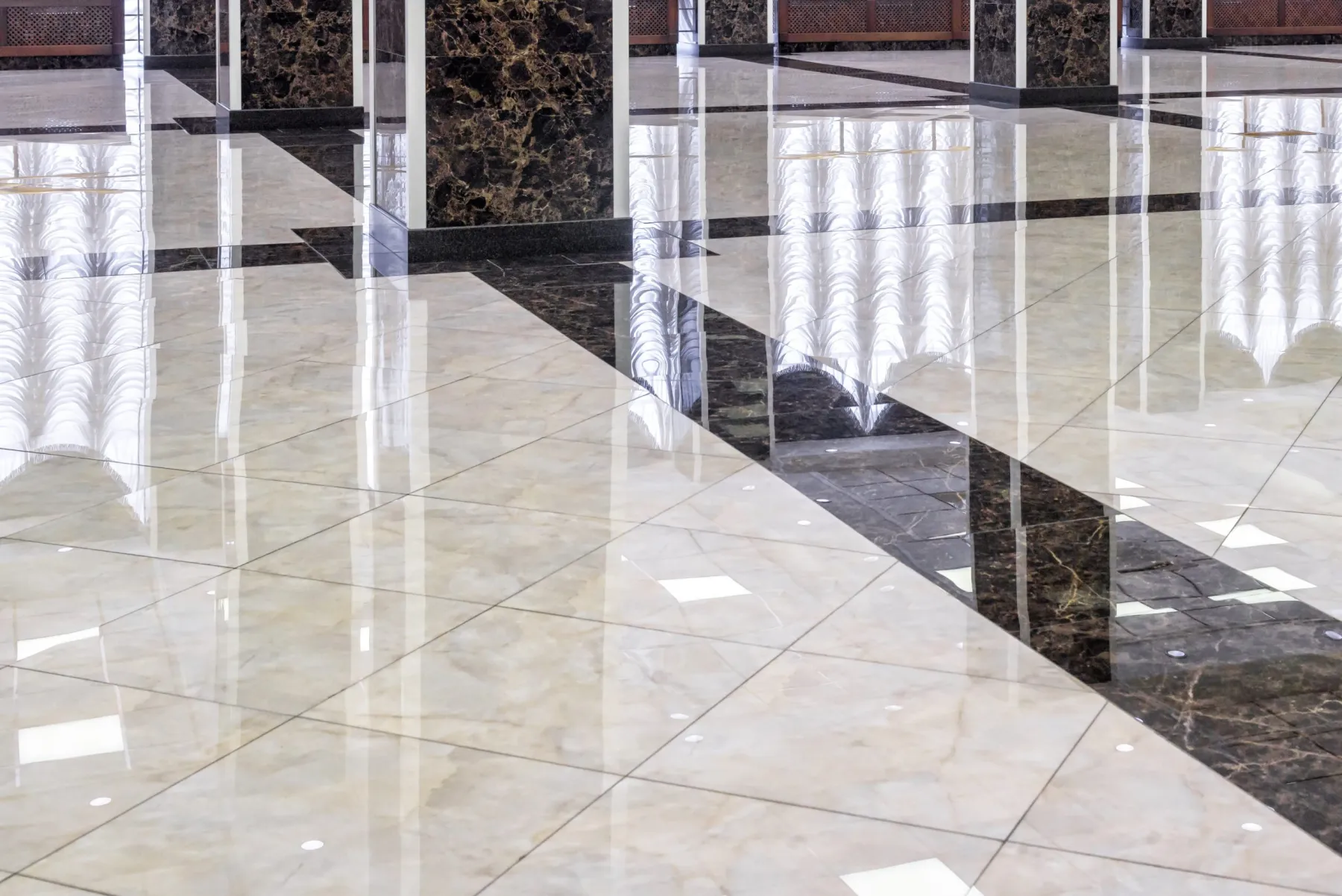
Material selection at the yard
You choose the material and then the actual slabs, which are tagged in your name. For a book-matched or heavily veined stone this is not optional — the slab you saw is the only one that will look like that.
Digital templating
Once the units, walls or substrate are installed and level, we template — usually by laser, which records the real out-of-square rather than the drawing. Cabinets must be fitted and levelled first; a worktop cannot be templated against nothing.
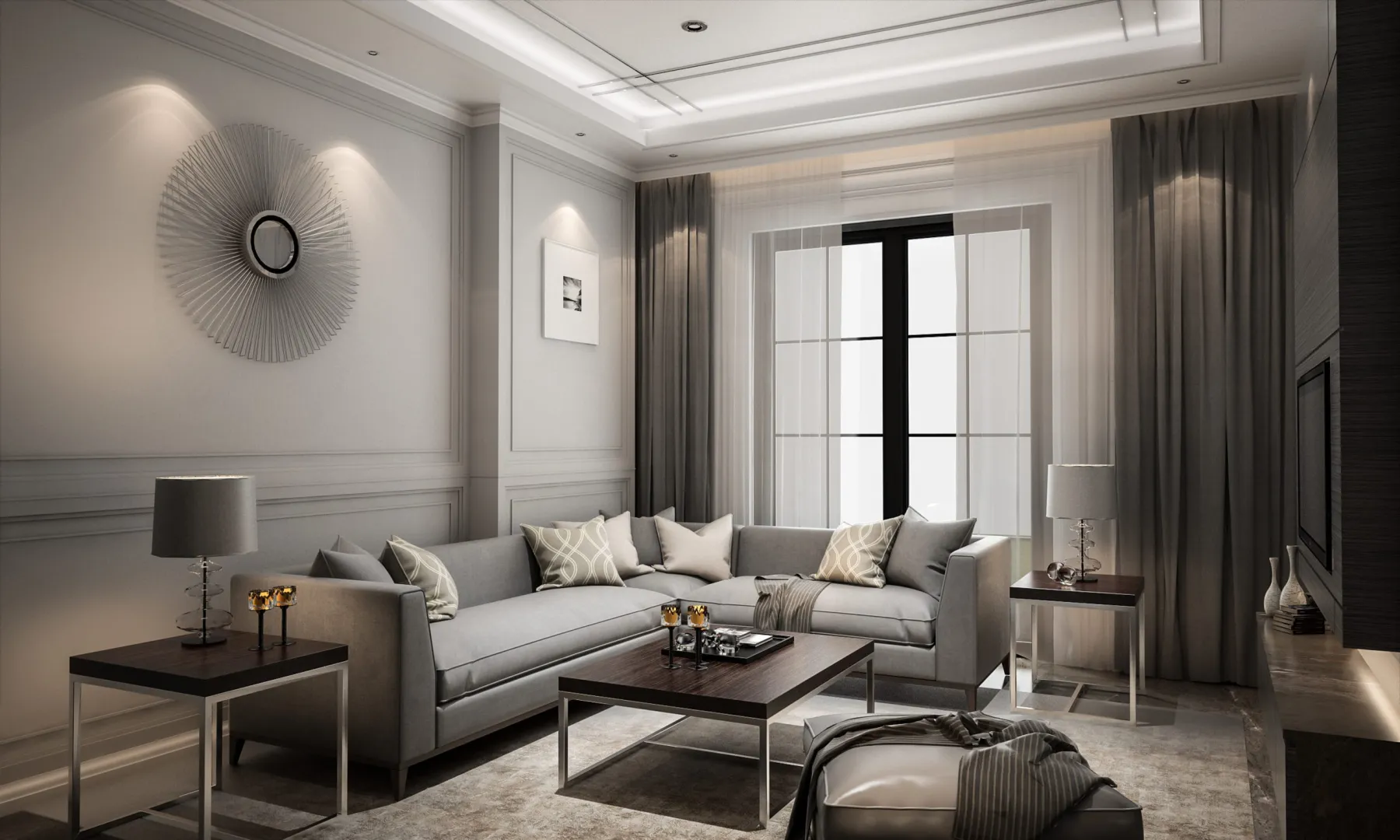
Slab layout and approval
The cuts are laid out on photographs of your specific slabs so you can see where the veining falls on the island, the splashback and the return. You approve the layout before the saw runs. Nothing about this can be undone later.
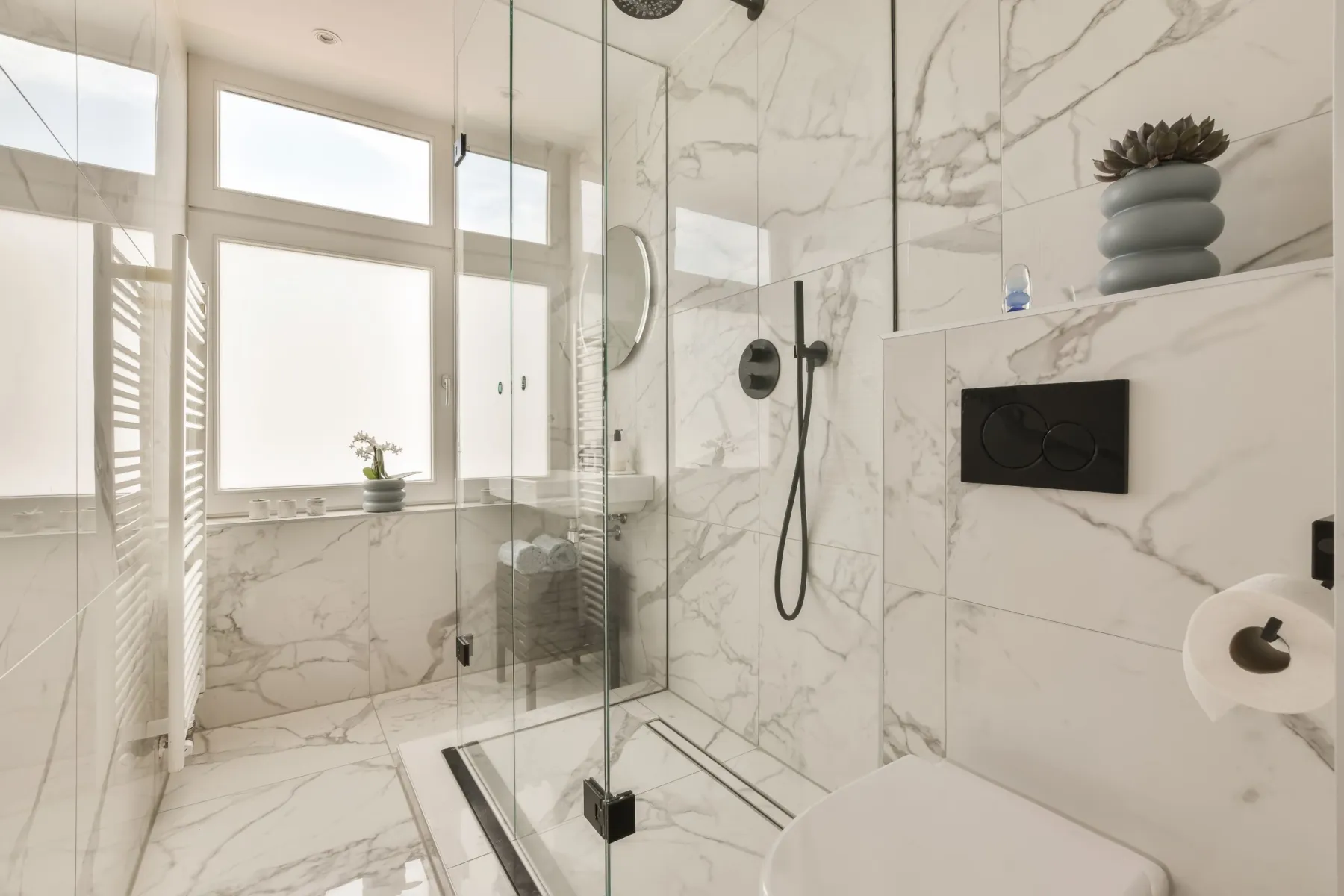
Fabrication
Bridge saw cutting, CNC profiling of edges and cut-outs, mitring, polishing and sealing. Seven to fourteen days depending on material and complexity. Book-matching and mitred returns sit at the longer end.
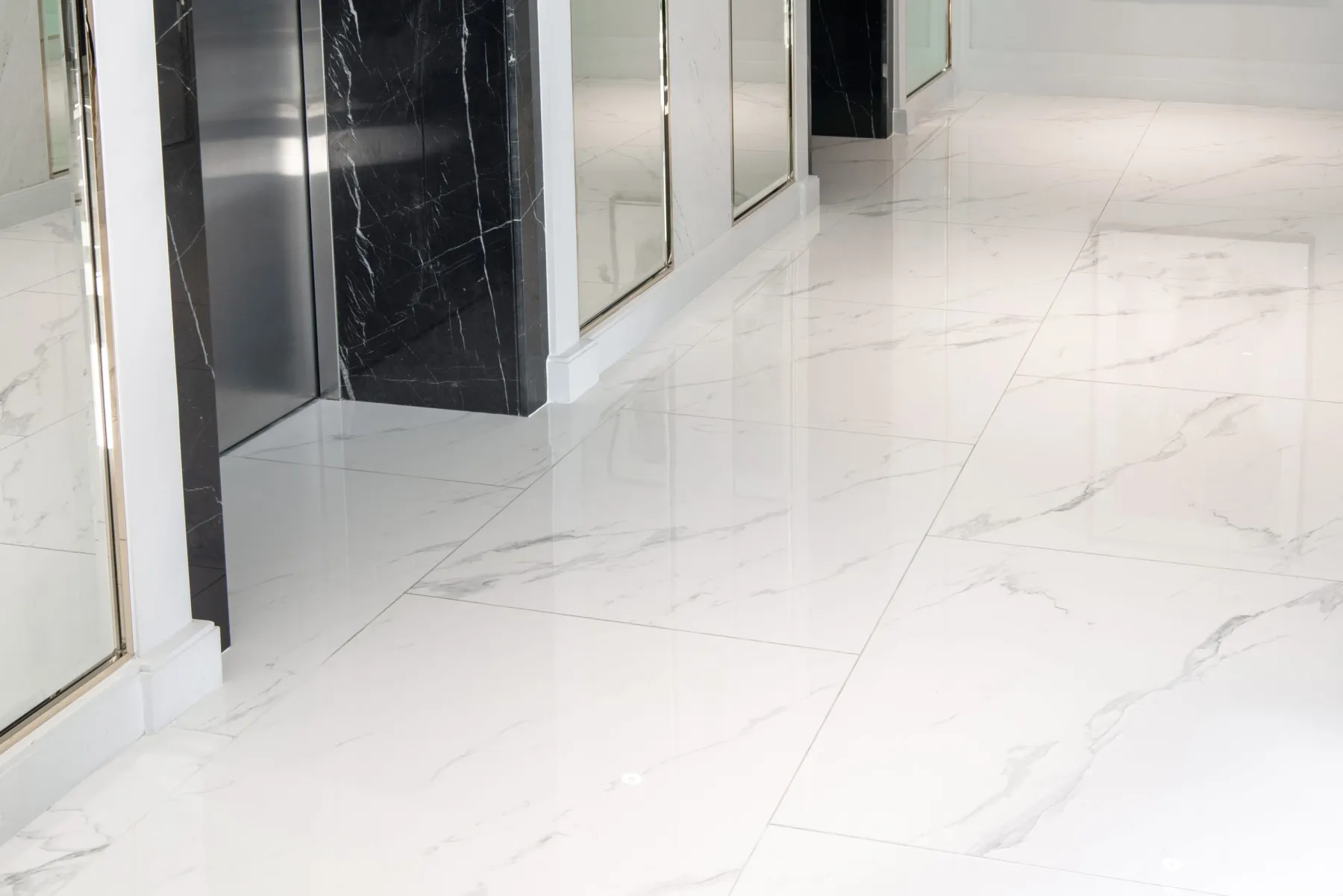
Installation and sealing
Delivered, dry-fitted, levelled and bonded, joints resined and polished flush, silicone to the perimeter, then sealed if the stone is porous. We leave the surface clean and tell you how to look after it.
Stone rates in Dubai
Supply, fabricate and install in Dubai, with a standard eased or pencil edge. Material is the largest variable — the same fabrication on a AED 200 quartz and a AED 1,200 marble gives very different totals.
| Item | Unit | Typical range |
|---|---|---|
| Engineered quartz worktop | per sq m | AED 280 – 650 |
| Granite worktop | per sq m | AED 350 – 750 |
| Marble worktop or vanity | per sq m | AED 420 – 1,400 |
| Porcelain or sintered slab | per sq m | AED 480 – 1,100 |
| Onyx or exotic stone, backlit | per sq m | AED 1,800 – 5,000 |
| Stone wall cladding, installed | per sq m | AED 320 – 900 |
| Book-matched feature wall | per sq m | AED 900 – 2,800 |
| Stone flooring, supplied and laid | per sq m | AED 260 – 750 |
| Staircase tread and riser | per step | AED 550 – 1,800 |
| Mitred edge build-up, 40–100 mm | per linear m | AED 180 – 420 |
| Undermount sink cut-out and polish | each | AED 250 – 550 |
| Drainer grooves machined | each | AED 300 – 650 |
| Impregnating sealer application | per sq m | AED 35 – 80 |
Stone is priced on the slab area consumed, not the finished surface area — offcuts around an island or a cut-out are paid for. Expect ten to twenty per cent wastage on a plain layout and considerably more on a book-matched one.
Living with stone in Dubai
Natural stone is porous and needs sealing. An impregnating sealer soaks into the surface rather than coating it, and it needs redoing every one to three years on a working kitchen worktop, less often on a vanity or a wall. Quartz and porcelain need none of this.
The enemy of polished marble is acid, not abrasion. Lemon, vinegar, wine, tomato and most limescale removers will etch a dull mark into the polish within seconds. Etching is not a stain — it is physical damage to the surface — and it is removed by re-polishing, which we can do in place.
Hard water is the other Dubai-specific problem. Limescale builds up fast on stone around taps and in showers. Wipe dry after use, and clean with a pH-neutral stone cleaner rather than a supermarket bathroom spray, most of which are acidic enough to etch marble.
Stone works: common questions
How much does a marble kitchen worktop cost in Dubai?
AED 420 to 1,400 per square metre supplied and installed, depending on the marble. A typical kitchen with an island consumes 6 to 10 square metres of slab, so AED 3,500 to 14,000 covers most jobs before edge build-ups and cut-outs.
Is quartz better than marble for a kitchen?
For durability, yes without question — quartz is non-porous, does not etch and needs no sealing. For appearance, marble has a depth engineered stone still cannot match. If the kitchen is genuinely used, quartz; if the look matters more than the patina, marble.
How long does a stone worktop take?
Seven to fourteen days from templating. Templating can only happen once the cabinets are installed and levelled, so plan for roughly two weeks between kitchen installation and a finished worktop.
Can I see the actual slab before it is cut?
Yes, and you should. We tag your slabs at the yard and lay the cuts out on photographs of them for approval, so you can see where the veining falls before anything is cut. This is the single most important step in a stone job.
Will marble stain in a Dubai kitchen?
It can stain if left unsealed, and it will etch from acids regardless of sealing. Sealed marble resists staining well. Etch marks from lemon or descaler are surface damage and are removed by re-polishing rather than cleaning.
Do you do stone flooring and staircases as well as worktops?
Yes. Flooring, staircase treads and risers, skirting, window sills, wall cladding and feature panels. Large-format flooring needs a properly prepared and level screed, which we check before laying.
Can you repair chipped or cracked stone?
Small chips are filled with colour-matched resin and polished flush, usually invisibly. Cracks can be stabilised and resined. A break across a narrow section, such as in front of a sink, is generally a replacement.
What thickness should the worktop be?
Twenty millimetres is standard for quartz and thirty for natural stone. Thicker-looking edges are achieved by mitring a return underneath rather than by using a thicker slab, which would be very heavy and much more expensive.
Come and choose your slab
Tell us the material you have in mind and we will arrange a yard visit, tag the slabs you like, and price the job against the actual stone rather than a guess.