Home › Residential › Theatre room
Home theatre rooms in Dubai, acoustics before electronics
Acoustic treatment and isolation, tiered seating, screen and projector geometry, blackout, lighting control and equipment joinery — built so the room does justice to the system rather than fighting it.
What a theatre room involves and what it costs
A home theatre room in Dubai covers acoustic treatment and isolation, seating layout and tiering, screen and projector or display geometry, blackout, lighting control, equipment storage and ventilation, and the joinery and finishes around all of it. Expect AED 60,000 to 150,000 for a dedicated room with acoustic treatment and seating, and AED 150,000 to 500,000 for a full isolated cinema with tiered seating and integrated AV. Abdulla Carpentry EST treats the room acoustically first, because the room contributes more to the sound than most of the equipment in it.
The most expensive mistake in home cinema is buying the system before building the room. A very good speaker package in an untreated room with hard walls, a hard floor and a glass door will sound worse than a modest package in a properly treated one. The room is part of the signal chain, and in a small room it is the largest part.
Untreated rooms do three things to sound. They reflect it, so you hear each sound twice, smeared. They reinforce certain bass frequencies and cancel others, so the bass is boomy in one seat and absent in the next. And they leak, so the film is audible throughout the house.
Treatment addresses all three: absorption at the first reflection points on the side walls and ceiling, bass trapping in the corners where low frequency energy accumulates, diffusion at the rear, and an isolated construction — an insulated partition to slab, a resilient ceiling, a solid core door with full seals — to keep it in the room. Then the electronics have something to work with.
 Room firstThen the electronics
The elements of a theatre room
A cinema is a technical room with a decorative finish. Almost every decision has an acoustic or an optical reason behind it.
Acoustic treatment. Absorption panels at the first reflection points on the side walls and ceiling, bass traps in the corners, and diffusion on the rear wall. Fabric-wrapped over mineral wool, detailed as panelling so the room looks designed rather than padded. See wall panelling.
Isolation. A double-boarded insulated partition built to the slab, a resiliently mounted or independent ceiling, a solid core door with a full acoustic seal set and a drop seal, and every service penetration sealed. This is what keeps a night-time film from reaching the bedrooms.
Screen and projector geometry. Seating distance set from the screen width, screen height so the centre sits at or just above seated eye level, and the projector throw and lens shift calculated rather than assumed. A short-throw or laser projector changes the ceiling design entirely.
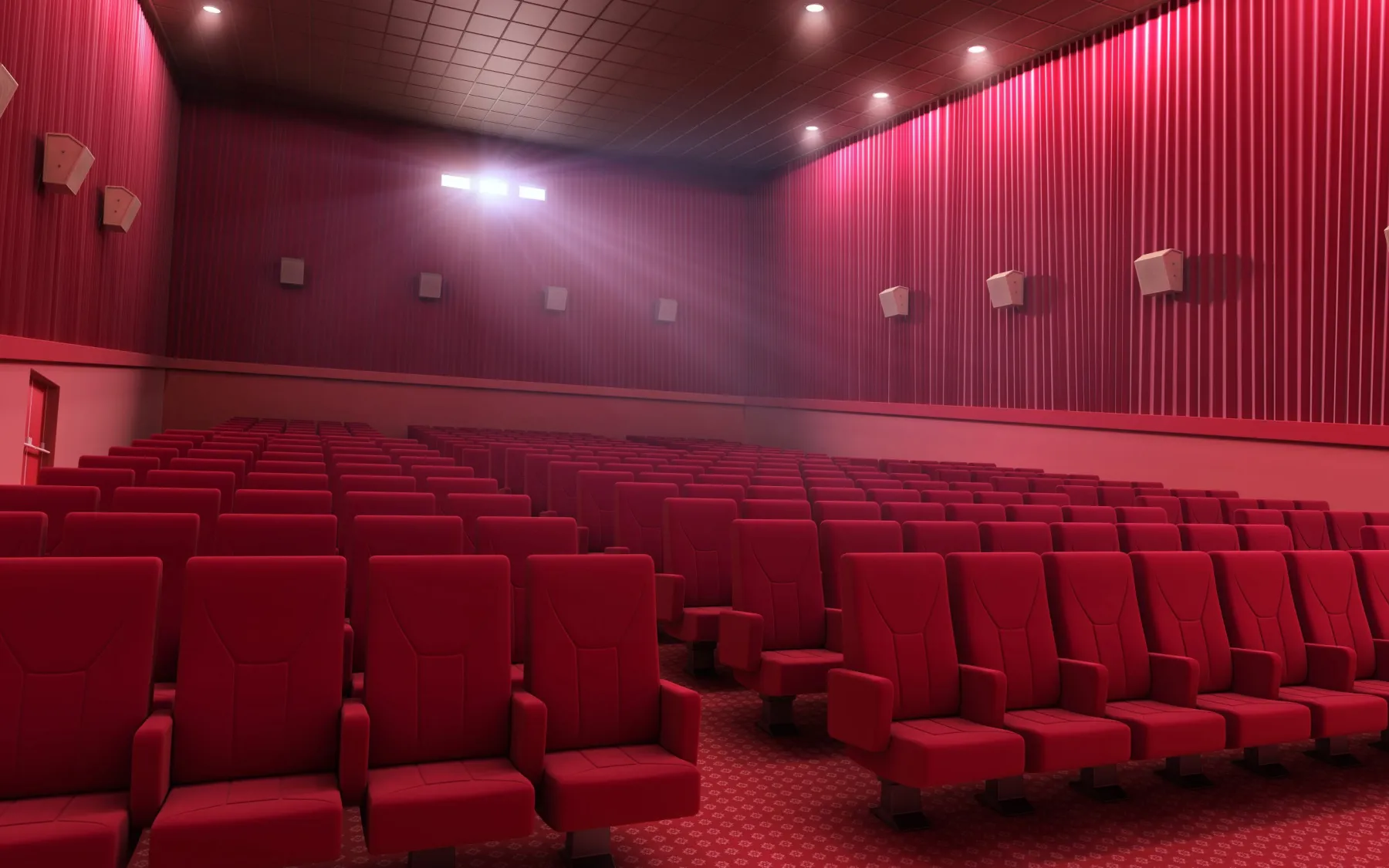
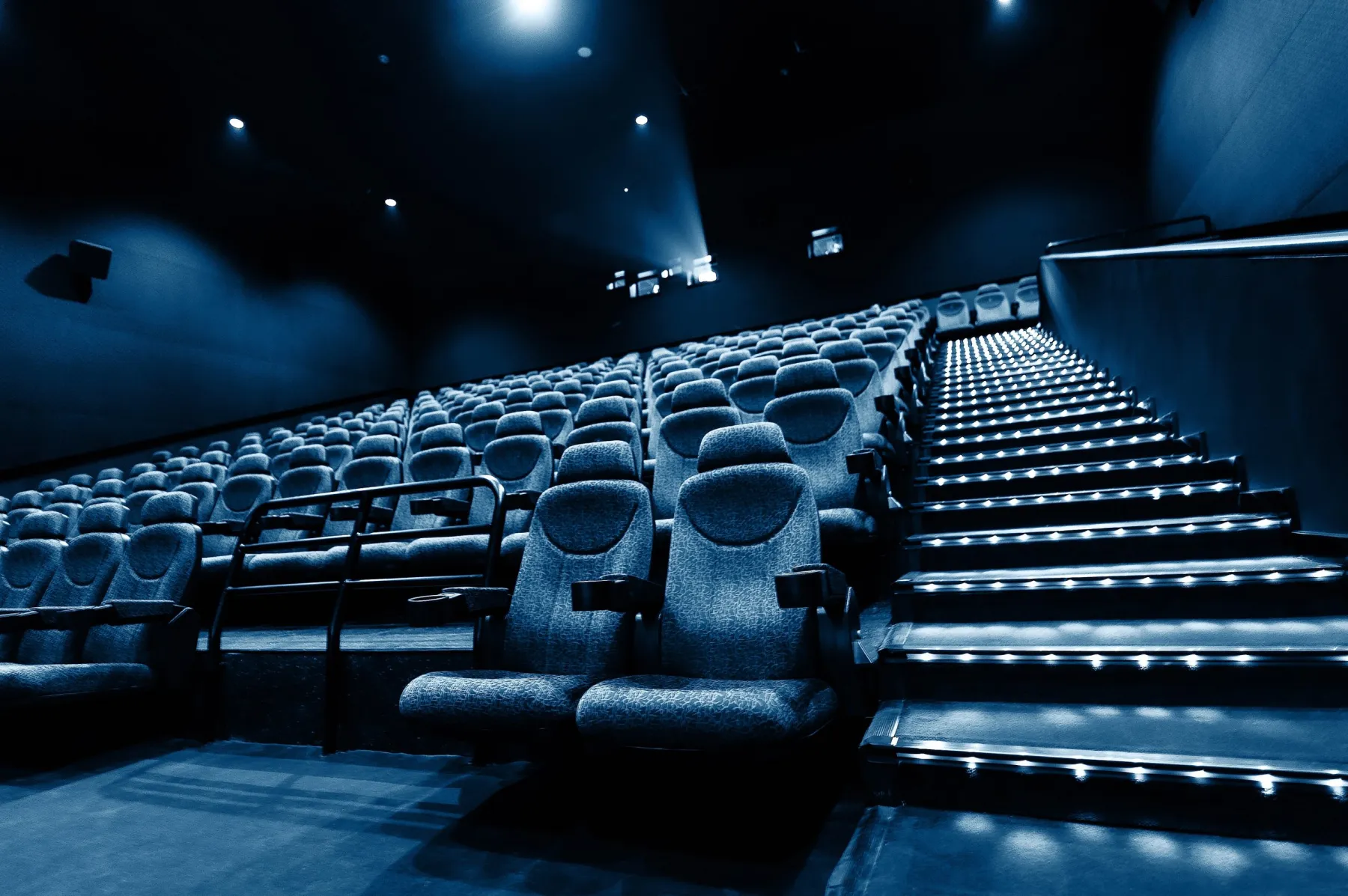
Seating and tiering. Two rows need a riser of about 300 to 400 millimetres for the back row to see over the front. That riser has to be built, finished and often contain the cabling, and it needs step lighting so nobody falls off it in the dark.
Lighting and blackout. Dimmable scene lighting, step and aisle lights, and a wall-wash for between films. Blackout on any window with a full side return and a pelmet, because a single bright edge destroys contrast on a projected image.
Equipment, ventilation and control. A ventilated equipment cabinet — AV amplifiers generate real heat — with cooling, cable management and a control system. Air conditioning designed to be silent at the seating position, because fan noise sits right in the dialogue range.
Seating distance, screen height and room proportions
Viewing distance is set from the screen width, not the diagonal. For a projected image, a comfortable range is roughly 1.5 to 2.0 times the screen width; for a flat panel, 1.5 to 2.5 times. Closer than that and the eye has to travel across the image; further and the immersion disappears.
Screen height matters as much. The centre of the image should sit at or slightly above seated eye level, roughly 1.1 to 1.2 metres from the floor for the front row. Screens mounted too high — which is very common, because the wall looks empty below — force the neck into an uncomfortable angle for two hours.
Room proportions affect the bass. A room where two dimensions are equal or simple multiples of each other reinforces particular frequencies badly. Where we have a choice, we avoid cubes and simple ratios; where the room is fixed, bass trapping in the corners and careful subwoofer placement do most of the correcting.
Speaker positions are set from the seating, not from the furniture. The front three across the screen at ear height, surrounds slightly above and to the sides of the seating, and subwoofers placed where the room supports them — which is found by measurement rather than by symmetry. All of that has to be decided before first fix, because the cabling and the joinery follow it.
1.5–2.0×Screen width to seating distanceHow a theatre room project runs
Survey and system brief
We measure the room, note its proportions and the surrounding rooms, and establish the system — projector or panel, speaker configuration, and how loud the room will actually be used. Those decide the isolation specification.
Design and acoustic plan
Seating and screen geometry set, speaker positions fixed, treatment plotted at the reflection points, isolation construction specified, and the whole thing presented in 3D with the finishes.
Isolation and first fix
Partitions built to slab with insulation, ceiling resiliently mounted, all AV and control cabling run, riser framed, and the ventilation designed for silence at the seating position.
Treatment, joinery and finishes
Bass traps and absorption installed behind fabric-wrapped panelling, screen wall built, equipment cabinet made and ventilated, riser finished, and lighting installed with step and aisle fittings.
Calibration and handover
Seating installed, system connected, then the room measured and the system calibrated to it — speaker levels, distances, room correction and the projector geometry — and handed over with the lighting scenes set.
Home theatre costs in Dubai
Room construction, treatment and finishes in Dubai. AV equipment is excluded unless we are asked to supply it; seating is priced separately.
| Item | Unit | Typical range |
|---|---|---|
| Dedicated theatre room, treated | per room | AED 60,000 – 150,000 |
| Isolated cinema with tiered seating | per room | AED 150,000 – 500,000 |
| Acoustic isolation partitions | per sq m | AED 190 – 350 |
| Resiliently mounted ceiling | per sq m | AED 180 – 400 |
| Fabric-wrapped acoustic panelling | per sq m | AED 450 – 1,200 |
| Bass traps, built in | each | AED 900 – 3,200 |
| Acoustic door with full seal set | each | AED 3,500 – 12,000 |
| Seating riser, built and finished | each | AED 4,500 – 16,000 |
| Screen wall with masking joinery | per project | AED 6,500 – 28,000 |
| Ventilated equipment cabinet | each | AED 4,500 – 14,000 |
| Scene lighting with step and aisle lights | per room | AED 6,500 – 32,000 |
| Blackout with pelmet and side returns | per window | AED 1,400 – 4,500 |
| Cinema seating, per seat | each | AED 3,500 – 22,000 |
| Silent air conditioning provision | per room | AED 9,000 – 35,000 |
Isolation and treatment usually account for more of the budget than the finishes do, and they are what the room is actually for. A modest system in a properly built room outperforms an expensive one in an untreated one.
When the room is not only a cinema
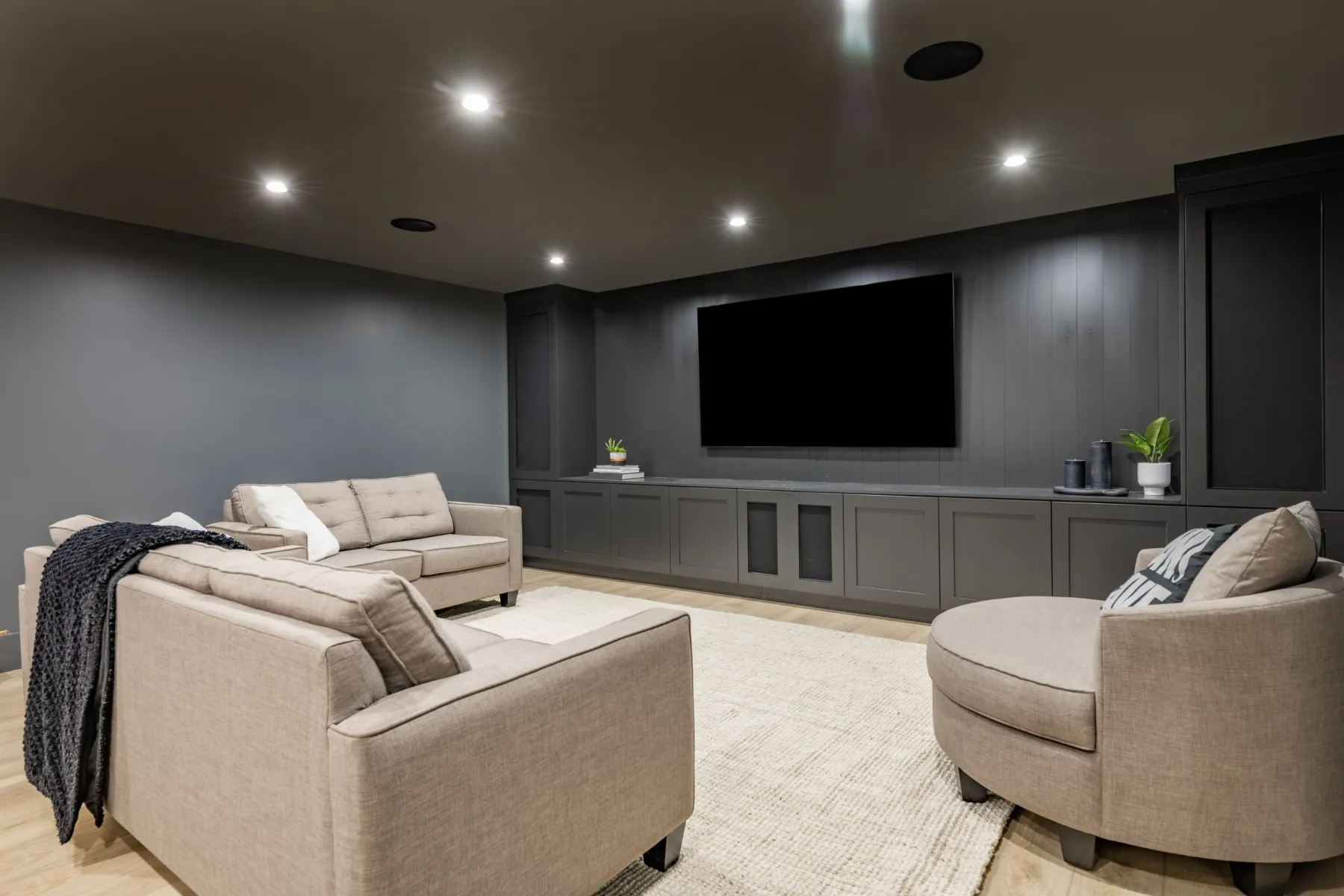
Many Dubai households want a media room rather than a dedicated cinema — somewhere to watch films properly, but also to watch a match with friends, play games and let children use the space. That changes the design sensibly: a flat panel rather than a projector, more forgiving seating, brighter lighting scenes and a finish that reads as a living room.
The acoustic work is still worth doing, because it benefits everything the room is used for. Treatment makes dialogue clearer, music better and conversation easier, and the isolation keeps a late match from waking the house. What changes is the visual language: slatted timber and fabric panels rather than a blacked-out box.
If the room is also a games room, the clearances for tables and the screen geometry have to be reconciled at the design stage rather than discovered later. See our game room page for the playing clearances involved.
Theatre room: common questions
How much does a home cinema cost in Dubai?
AED 60,000 to 150,000 for a dedicated treated room with seating, excluding AV equipment. A fully isolated cinema with tiered seating and integrated systems runs AED 150,000 to 500,000.
How long does it take?
Ten to sixteen weeks. Isolation construction and first fix take three to four weeks, joinery and treatment manufacture runs four to six weeks in parallel, then installation, finishes and calibration.
How far should the seating be from the screen?
Roughly 1.5 to 2.0 times the screen width for a projected image and 1.5 to 2.5 times for a flat panel. Screen centre should sit at or just above seated eye level, around 1.1 to 1.2 metres from the floor.
Do I really need acoustic treatment?
Yes, and it is the highest-value spend in the room. An untreated room smears the sound with reflections and produces uneven bass, and no amount of equipment corrects that. Treatment is what lets the system you bought actually perform.
Can you stop the sound reaching the rest of the house?
Substantially, yes — a double-boarded insulated partition to slab, a resiliently mounted ceiling, a solid core door with a full seal set and every penetration sealed. Complete isolation is possible but expensive; this combination handles normal night-time use.
Projector or a large flat panel?
A projector for a dedicated dark room and the largest image. A flat panel for a multi-use media room, where there is ambient light and the room is not blacked out. The choice changes the seating distance, the ceiling and the lighting design.
Do I need a seating riser?
Only for a second row. A riser of 300 to 400 millimetres lets the back row see over the front, and it needs step lighting. For a single row it adds nothing and takes ceiling height away.
Where does the equipment go?
In a ventilated cabinet, either in the room or in an adjacent space. AV amplifiers produce real heat, and an unventilated cupboard shortens their life and can cause shutdowns mid-film. We build the cabinet with cooling and cable management as part of the joinery.
Tell us the room and the system
Room dimensions, ceiling height, what is above and beside it, and the system you have in mind. That is enough for us to specify the isolation and treatment and come back with a design.